Thursday, November 18, 2021

Blogger #26 - Charith Senanayake - Period 9 - 11/18/2021

 Aim: How can we, as students of literature, evaluate the value of Lord of The Flies through a dissection of themes and motifs?


Do Now: Now that you’ve read the entire novel, what do you believe the major themes of the novel are? Why?

The class answered with: 

  • The need for order in a society

  • The destructiveness human nature when there’s no regulations

  • Man’s inherent evil


Theme: A broad idea, message, or lesson that is conveyed by a work. 


Motif: Any recurring element that has a symbolic significance to the literary work


Deus ex machina: A plot device where a seemingly unsolvable problem is abruptly and suddenly resolved by the contrived and unexpected intervention of some new event, character, ability, or object. Depending upon how it is done it can be intended to move the story forward when the writer has “painted himself into a corner” and sees no other way out.


Group Work: Which is a theme, which is a motif? Why?


Loss of Innocence = theme (it’s not specific to Lord of The Flies)

Piggy’s Glasses = symbol, motif
Negative Consequences of War = theme (universal)

Civilization vs Savagery = theme

The Pig = motif

The Beast = motif 

Individuality vs Conformity: theme


*John-Pierre Alkhoury brought up the idea that the beast was a theme and talked about how the beast represents all that’s bad in society, and is thus universal. However, Miss Peterson told him that the beast in this book was specific to this book and was therefore a motif.


  • Originally, the conch brought the boys together. It symbolized the keeper of the rules, law, order, and civilization. What do you think happened to this belief after Piggy was hit by the rock?

In the beginning of the book, the conch held so much importance. Whoever held it commanded the discussion. But over the course of the story, it loses its power and its importance. When Piggy tries to use it to stop a fight between Ralph and Jack, he is met with comments like “Get out, fatass!” Piggy is under the impression that the conch still holds power. However, this couldn’t be further from the truth since the boys on the island have already lost their humanity. This is evident in the frequent fights and their thirst for blood. They seem to have no conscience, and they’re now indistinguishable from animals.

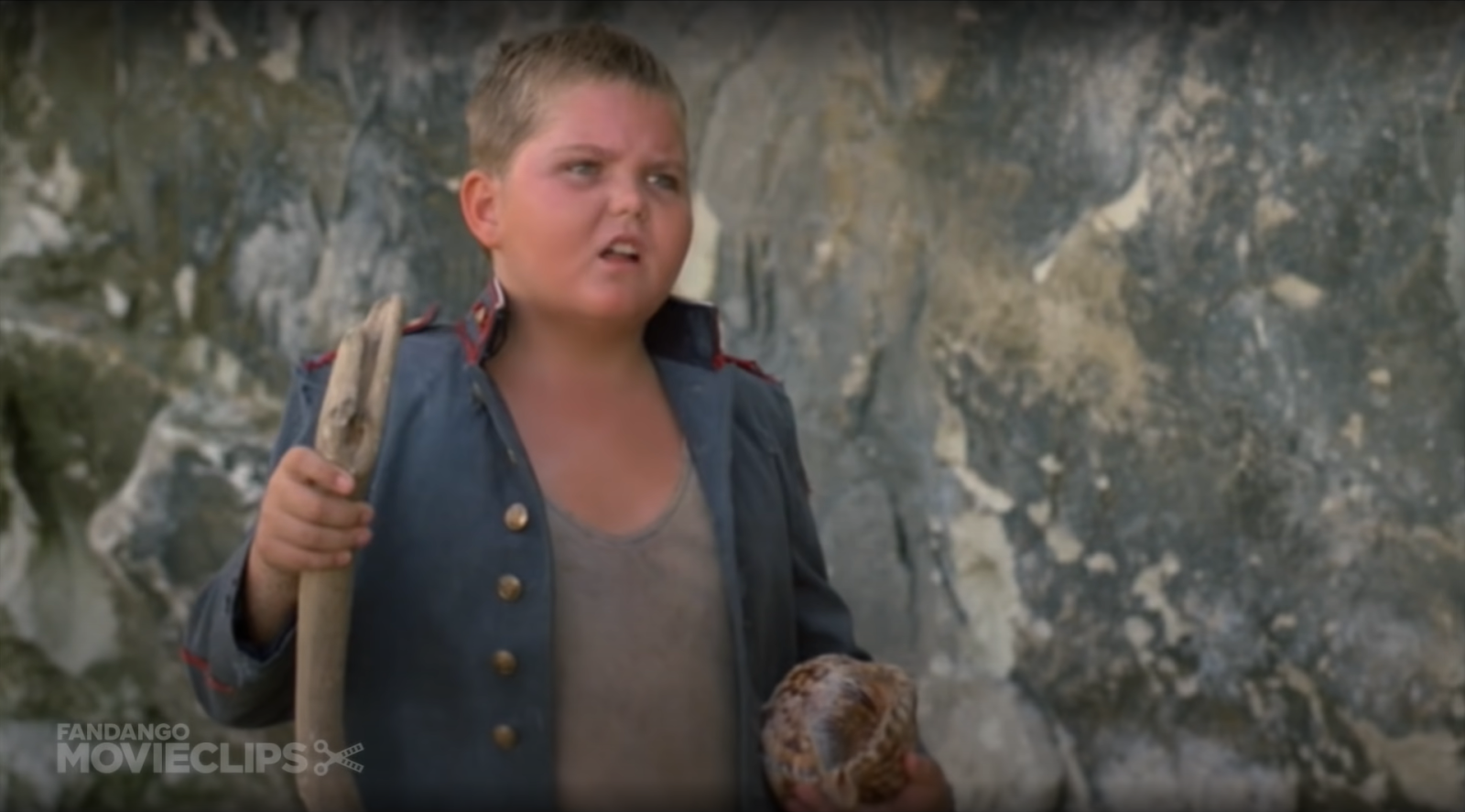
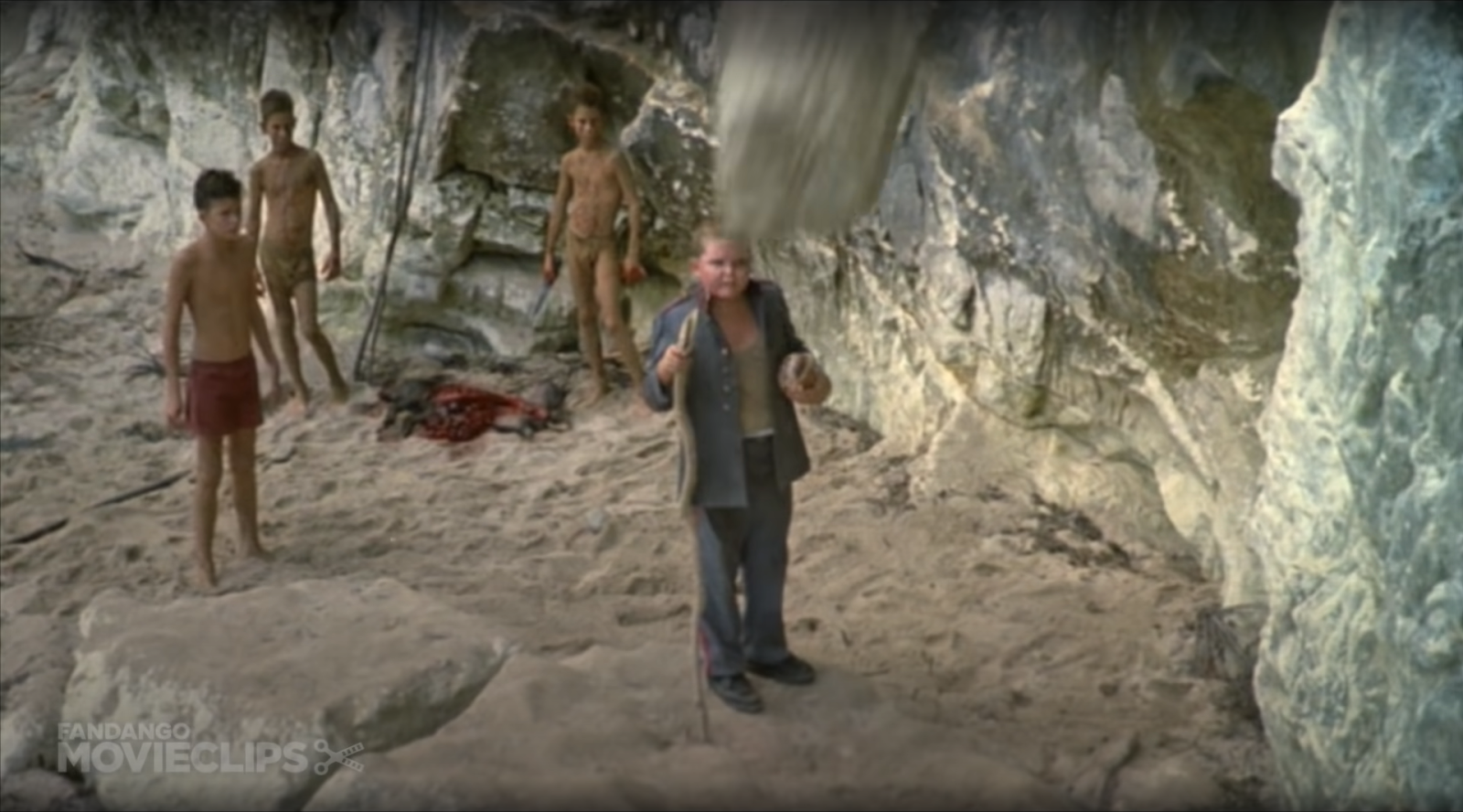
When Piggy is crushed to death and the conch is crushed with him, it’s all gone. 

Civilization, law, rules, and order are no more. The conch no longer has any power.


  1. What is a theme? What is a motif?

A theme is timeless and universal, you can find the same theme in many works of literature, such as “power leads to corruption”.

A motif is specific to one work. Not all symbols are motifs! (symbols have to be used repeatedly in order to become motifs)

  1. Why is it necessary to evaluate these elements in literature?

Analyzing themes and motifs is an essential part of understanding literature. It helps us better understand the author’s intent. Additionally, we can apply these themes to our lives and the present day.

  1. What are the major differences between theme and motif?

Themes are universal and applicable throughout literature, but motifs are limited to single works.

  1. Are all symbols motifs? Why or why not?

No, all symbols are not motifs because in order to be a motif, a symbol needs to be consistent throughout the entire text. Some symbols are only used once, and thus aren’t motifs.


Nearing the end of class, Ms. Peterson tells us how to relieve some testing anxiety and teaches us how to study for the test on Monday. She says that studying in the bedroom is unproductive since the bed is conducive to relaxing. Studying outside is better since the white noise that nature creates helps you think. Studying with music can also help. All in all, the place of studying should have no distractions. 

*Organizing and color-coding helps you to remember information.


Miss Peterson says, “My last caveat for all of you is the following”

Sort your notes into three categories:

  1. Stuff you’re sure of

  2. Material you somewhat know.

  3. Stuff that makes you go, “I have no idea, I don’t remember learning this at all.”

This process makes studying more manageable, less scary, and more efficient. You start by studying what you’re least familiar with.


  • Reflection:

Today in class, I learned about themes and motifs. I learned how to identify and interpret these in literature to better my understanding of the author’s message and the underlying commentary. I can apply these universal themes in my life to view my world more critically. I can analyze my actions and rationalize them using psychology. The studying tips that Ms. Peterson gave us will definitely help me in the future.


Blogger #26 - Viviana Rescalvo Orea - Period 3 - 11/18/21

Aim: How can we, as students of literature, evaluate the value of Lord of the Flies through a dissection of themes and motifs?

We started the class off with a do now of finding some major themes present in the novel. Some themes that could be identified were…
  • There's evil in every man and savagery in the root of every civilization
  • Man vs nature - having to learn to survive and being in the natural world lets us see our true nature
However, if there was any confusion on what could be considered a theme or a motif, we were given these definitions.

Theme- a broad idea, message, or lesson that is conveyed by a work.
Motif- any recurring element that has symbolic significance in a story.

Here are some more tips to know the difference between the two.

We were also presented with a new word
Deus ex Machina
  • A plot device where a seemingly unsolvable problem is abruptly and suddenly resolved by the contrived and unexpected intervention of some new event


Well, how can the themes we identified in our do now be categorized as a theme? The themes that the class came up with are universal. They can be seen throughout many different works of literature but are not only subjected to literature. They can be seen through history too! This is what makes them timeless. On the other hand, we have motifs, which are specific to one work. For example, the conch in the novel symbolizes how the order of civilization slowly starts to descend into savagery over time as the conch slowly starts to lose its purpose.


Now it was time to put what we learned to the test. We worked in groups to categorize these into either themes or motifs.
  • ​​Loss of innocence - theme 

  • Piggy's glasses- motif

  • Negative consequences of war- theme

  • Civilization vs savagery- theme

  • The pig - motif

  • The beast- motif

  • Individuality vs conformity- theme 


We then watched this short clip to sum up last night's reading.

https://www.youtube.com/watch?v=TQCgzi4j3eM

Here we discussed as a class what we noticed in the reading. As Piggy is hit and killed by Roger with a boulder he levered with a spear, the conch also breaks. There is great significance in this, it shows how the boys now have no more order. They have ascended so far into savagery that they don't even realise the wrong in killing Piggy. This elaborates on the conch being a motif in the story. Along with this motif, we also see some foreshadowing. Throughout the story, we see Roger always around a boulder and spear (this is what kills piggy) and foreshadows what's to come.


For a quick summary, we answered the question: Why is it necessary to evaluate these elements in literature? It is important to identify these elements in order to be able to fully understand what the author is trying to convey. Along the way, we can connect dots to see why the author put in specific details.

Lastly, we ended our class with tips and tricks about test taking. One tip is making sure you study somewhere that is not your resting place as it will only drive away your attention. A second tip is reviewing multiple subjects at once since it will allow your brain to make connections. One last tip is breaking up notes into 3 categories, the first being what you know best, second being what you somewhat know, and the third being the most important things to go over. This way will help in managing your time most efficiently.


Reflection: 

Now with this information, I can clearly identify and explain the difference between themes and motifs and why they pertain to different pieces of the story. This is very beneficial not only to understanding Lord of the Flies, but any other work. It will help draw connections quicker and aid in finding different literary devices. It is now clearer why there are certain details that might not make sense at first. If we view it from a broader perspective, we can make more links to different parts of the story.

Blogger #5- Tiffany Chen-Period 2- 11/18/2021

 Aim: How can our examination of Joseph Campell’s “The Hero’s Journey” expose Odysseus as an archetypal hero?


Do Now: Interpret the following quote and apply it to Odysseus

      “A hero ventures forth from the world of common day into a region of 

        supernatural wonder. Fabulous forces are there encountered and a decisive 

    victory is won.” 


My answer: When Odysseus fought in the Trojan War, he left behind his kingdom and his comfortable life with his wife Penelope as well as his newborn son. During his trip back to Ithaca, he faced many challenges with supernatural wonders in it. Such as the cyclops and sirens.


Classmate answers: 

  • In the Greek world, not many got the favor of the gods but Odysseus had it. This goes with the supernatural wonder in the quote.


  • He left his kingdom for the Trojan war. While returning home, he was faced with many obstacles.


Information on Joseph Campbell and “The Hero’s Journey”

Joseph Campbell, an American psychologist and mythological researcher, wrote a famous book entitled The Hero with a Thousand Faces. 


In his lifelong research, Campbell discovered many common patterns running through hero myths and stories from around the world. These years of research lead Campbell to discover several basic stages that almost every hero-quest goes through (no matter what culture the myth is a part of).


He calls this common structure “the monomyth.” 


It is commonly referred to as "The Hero's Journey." 


First video - What makes a hero? - Matthew Winkler


Joseph Campbell studied myths from all over the world and published a book called “The Hero with a Thousand Faces” which explained how each stories represented the monomyth/ Hero’s Journey


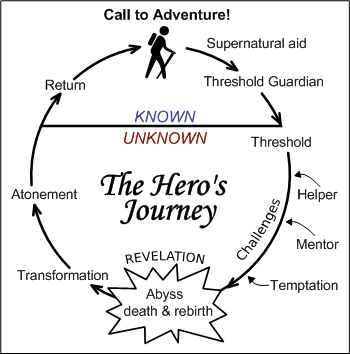
Hero’s Journey = a cycle where the journey ends and begins in the hero's ordinary world, but their quest takes place in an unfamiliar, special world

1:00 - Call to Adventure = the hero receives a mysterious message

2:00 - Assistance = the hero gets help from someone older and wiser

3:00 - Departure = the hero crosses the threshold from his normal, safe home, (ordinary world) and enters the special world

4:00 - Trials = the hero solves problems, slays monsters, and escapes from a trap

5:00 - Approach = the hero faces the biggest ordeal and their worst fear

6:00 - Crisis = the hero faces death and possibly even dies (hero’s darkest hour)

7:00 - Treasure = the hero is reborn and gains a treasure, special recognition, or special power

8:00 - Result = the monsters can bow down to the hero or chase him as he flees from the special world

9:00 - Return = the hero returns to his ordinary world

10:00 - New Life = the quest has changed the hero and he has outgrown his old life

11:00 - Resolution = all the tangled plot lines get straightened out

12:00 - Status Quo = Hero is updated to a new level

What is an Archetype?

  • An original model or pattern from which other later copies are made, especially a character, an action, or situation that seems to represent common patterns of human life.

  • Often, archetypes include a symbol, a theme, a setting, or a character that have a common meaning in an entire culture, or even the entire human race.

Some examples of archetypal characters are “the evil genius”, “the hero”, or “the damsel in distress.

Archetypes Found in Myths:

  • HEROES: Central figures in stories. Everyone is the hero of his or her own myth.

  • SHADOWS: Villains, enemies, or perhaps the enemy within. This could be the repressed possibilities of the hero, his or her potential for evil.

  • MENTORS: The hero’s guide or guiding principles.

  • HERALD: The one who brings the Call to Adventure. This could be a person or an event.

  • THRESHOLD GUARDIANS: The forces that stand in the way at important turning points, including jealous enemies, professional gatekeepers, or even the hero’s own fears and doubts.

  • TRICKSTERS: Clowns and mischief-makers.

  • ALLIES: Characters who help the hero throughout the quest.

  • WOMAN/MAN AS TEMPTRESS: Sometimes a character offers danger to the hero by attempting to lure them from their quest.


Second video - Netflix's Myths & Monsters: Joseph Campbell & The Hero's Journey ("Heroes & Villains," S1E1)


  1. Identify at least 2-3 examples of archetypes, as seen in The Odyssey.


Hero: Odysseus

Lover: Penelope

Rebel: Eurylochus

Temptress: Sirens, Calypso, Circe, Lotuses

Allies: Telemachus, Odysseus’s comrades

Innocents: Penelope, Telemachus


Third video - The Hero's Journey in 5 Minutes 


HW: IN GOOGLE CLASSROOM - Joseph Cambell’s Monomyth Framework 

*Due 11/19/2021 at 10 PM*


Using the supplemental worksheet (19 Joseph Campbell’s - Monomyth framework)with this lesson (that you will also be using for homework) along with this diagram, apply Joseph Campbell’s theory to Homer’s Odyssey.

  • Complete the chart/table tracking Odysseus’ path through the Hero’s Journey.

  • *You can incorporate images into your chart*


After completing the chart, answer this last question:

Assess Odysseus’ status as a hero through the lens of Campbell. 

➢We’ve had multiple discussions about his status as a hero with many of you arguing both for and against him. With the application of Campbell’s theory of hero, has Odysseus emerged as more (or less) of an archetypal hero? Explain your answer below!


Reflection:

In today’s lesson, we learned about Joseph Campbell’s “The Hero’s Journey” and how Odysseus was an archetypal hero. We also identified other archetypes from The Odyssey and learned about the different steps in a Hero’s Journey/ monomyth.

    Joseph Cambell studied myths from all over the world and created the book “The Hero’s Journey”. It explains how each myth goes through the Hero’s Journey, the cycle that begins and ends in the hero’s ordinary world, but its journey takes place in a special world. The hero’s ordinary world is the world he is used to and feels comfortable in. The hero’s special world on the other hand is the world with challenges at which the hero has to overcome. Ms. Peterson showed us a video and a picture of the cycle in the Hero’s Journey. The video is extremely helpful because it illustrates and explains the Hero’s Journey in a quick and easy way to comprehend.

    Next, we learned about the archetypes in myths. Archetypes are characters, actions, or situations that keep recurring. Archetypes include symbols, themes, settings, or characters that have a common meaning in a culture or human race. Ms. Peterson gave us a list of the many archetypes there are as well as what they mean. Then, we were asked to identify characters from The Odyssey and shared our answers. This helps us understand the different archetypes and their roles more.


Blogger #3- Noah Chan- Period 2- 11/16/2021

 Aim: How does Odysseus establish his authority as an epic hero in the episode of   "The Challenge" and "Odysseus‘ Revenge”?


Do Now:             WHOLE CLASS DISCUSSION

The  Ancient Greeks viewed revenge as a form of social justice.  They believed that if a horrid wrongdoing was done upon them, they had the right to return the favor; in whatever means they found just.  The Greek values greatly resembled the Hammurabi Code of Law for Justice:  “An eye for an eye, a tooth for a tooth” mentality, meaning that whatever crime the perpetrator committed, the punishment brought upon him should be equal or fitting of the crime.


1. How does this compare to the way our society views revenge today?  

2. How does it compare to the way that you view revenge?


Our class had a WHOLE CLASS DISCUSSION which is when one student answers the question and chooses another student to answer the same or different question. We responded by discussing how, in today's world, society often considers revenge as an unacceptable approach to retaliate for someone's wrongdoing. Revenge is the action of inflicting hurt or harm on someone for an injury or wrong suffered at their hands.


Notes

Words to know

implacable (adj): unrelenting, stubborn; impossible to calm or appease.

quiver  (n): a portable case for holding arrows

entrails  (n –pl): internal organs, the intestines; within


Our class proceeded to spirit read “The Challenge” [2 pages] then “Odysseus’ Revenge” [4 pages]. (I attached the link)


WHOLE CLASS DISCUSSION

“But the man skilled in all ways of contending, satisfied by the great bow’s look and heft, like a musician, like a harper, when he draws with quiet hand upon his instrument he draws between his thumb and forefinger a sweet new string upon a peg; so effortlessly Odysseus in one motion strung the bow. Then slid his right hand down the cord and plucked it, so the taut gut vibrating hummed and sang a swallows note” (Homer 1370-1379).


  1. What epic simile is created in the lines above, from “The Challenge”? Explain the comparison.


I responded by explaining how the epic simile compares Odysseus pulling his bow to a musician playing his instrument. This implies that he is as skilled in this art as a musician is in playing their instrument.


  1. Which of Odysseus’ qualities are being highlighted here?

    1. How is Homer presenting Odysseus to the audience?


I believe Odysseus' attributes of talent and glory are shown in this excerpt. Odysseus is seen holding his bow in the same way as a musician holds his instrument.


Acting The Odyssey 1997 (Odysseus’ Revenge) [9:18]

ENRICHMENT

Law and Justice - Justice and Vengeance: Homer - 3.5 Debate: Revenge in Justice? [3:10]


TEAMWORK


  1. Why does Odysseus invoke Apollo in line 1411?

My team said Odysseus invokes Apollo because he was asking for help.

  1. In the episode of "Odysseus' Revenge,“ who is the first to die? Describe the immediate reaction of the suitors to this initial killing.

My team said the first to die was Antinous. After the initial killing, they all tried to fight back.

  1. What argument does Eurymachus use to try to persuade Odysseus to spare him and the others?

    My team said Eurymachus says that he did commit crimes and took care of his wife, Penelope.

  1. What three crimes of the Suitors does Odysseus mention when he begins the slaughter (lines 1438-1444)?  


    My team said their world, his world, and his house.


  1. Why do you believe Odysseus denies Eurymachus’ request to provide restitution for all they have consumed, and then some (lines 1467-1473)?


    My team said Odysseus thinks that everyone should pay the price of death.


  1. List at least two images/examples of figurative language that help you picture some of the most tense or most horrifying moments in the battle. Include line references!

    My team said lines 1531-1533 and lines 1522-1524.

  1. Odysseus is described as "implacable" in the revenge episode. Is he justified in killing all of the suitors?  Why or why not?

    My team said he is justified in killing all the suitors because Odysseus believes that the individuals he has trusted have deceived him. He sees vengeance as the only way to restore order in his home. That way, he will be able to restore his family and crown.


Analyze both paintings depicting Odysseus killing the suitors.  Do you believe the artists accurately depicted Odysseus’ attack on the suitors?  Would you evaluate this to be a “fair” fight-- why or why not?

Due to Odysseus being stronger than all of the suitors, yet he was still only one person against many, I judged that this was a "fair" fight.


ENRICHMENTS

What Is Justice?: Crash Course Philosophy #40 [10:15]

Is Revenge More Bitter Than Sweet? [4:01]

The Odyssey by Homer | Books 17-18 Summary and Analysis [2:58]

The Odyssey by Homer | Books 19-20 Summary [3:04]and Analysis 

The Odyssey by Homer | Book 21 Summary and Analysis [2:21]

The Odyssey by Homer | Book 22 Summary and Analysis [1:58] 


Reflection

Today in class, I studied about Odysseus in "The Challenge" and "Odysseus' Revenge" from "The Odyssey." I studied the Ancient Greek habit of vengeance and how it was legitimately employed in their society. In this section of the narrative, Penelope organizes a contest for her hand in marriage to determine which of the suitors can successfully fire a bow and arrow through twelve axhandle sockets. Odysseus, dressed as a beggar, completes the challenge and reveals himself. The suitors are taken aback since they assumed Odysseus had perished along the way. Odysseus then seeks to exact revenge on the suitors who were attempting to take his life, which he had fought hard to construct.