Thursday, December 2, 2021

Blogger #8, Jessy Chui, Period 2, 11/24/21. Freshman Lit 2021

 Blogger #8, Jessy Chui, Period 2, 11/24/21. Freshman Lit 2021


2 Julius Caesar: I.i Lesson


Aim: What is revealed in the exposition of Act I, scene I of Shakespeare’s, Julius Caesar?


Do Now: PAIR/SHARE NOW--CLASS DISCUSSION LATER 

What do you believe a playwright will establish at the opening of his or her play? Why?


My group believed that a playwright will establish the setting and the main characters of the start of their play to set the story. This will help to make the story more cohesive when the audience is watching it.


We then read the text, “Putting the “I” in “Ides”” through spirit reading. Afterwards, we also discussed how the images related to the life of Caesar, including his relationship with Cleopatra shown by the image on the bottom left. and his quote “Veni, Vidi, Vici” to the right of it.
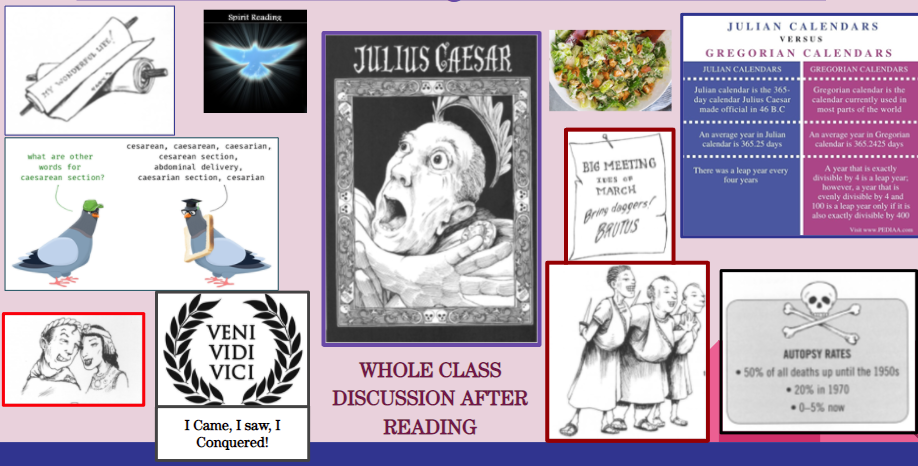

We learned about the First Triumvirate as well as Caesar’s history with Pompey. 

We were asked the question: Why do you think Shakespeare chose to compress the actual historical time frame of “3” years into a period of only “6” days?


My team answered that shortening these three years would make a more easily digestible story for the viewers, and it would also make the story of Caesar more entertaining than listening to a more lengthy version. A period of only 6 days keeps the story concise and would make it easier to remember and understand.


Pun: A pun is a play on words. A person might use a word to suggest two or more meanings at the same time or use two different words that sound alike to create humor.


Patricians: aristocratic landowners who held most of the power 

Plebeians: common farmers, artisans, and merchants who made up the majority of the population 

Triumvirate: a group of three rulers 

Tribunes:  Roman officials whose task it was to protect the people against oppression

Soothsayer:  fortune teller (Remember Tiresias from the Odyssey)


The definitions of the words above helped to understand the reading better.


Then, we read and listened along to Julius Caesar - Act I, scene i [2 pgs]


Julius Caesar

Act I, scene i

Rome. A street.

Enter FLAVIUS, MARULLUS, and certain Commoners

FLAVIUS

Hence! home, you idle creatures get you home:

Is this a holiday? what! know you not,

Being mechanical, you ought not walk

Upon a labouring day without the sign

Of your profession? Speak, what trade art thou? 5

First Commoner

Why, sir, a carpenter.

MARULLUS

Where is thy leather apron and thy rule?

What dost thou with thy best apparel on?

You, sir, what trade are you?

Second Commoner

Truly, sir, in respect of a fine workman, I am but, 10

as you would say, a cobbler.

MARULLUS

But what trade art thou? answer me directly.

Second Commoner

A trade, sir, that, I hope, I may use with a safe

conscience; which is, indeed, sir, a mender of bad soles.

MARULLUS

What trade, thou knave? thou naughty knave, what trade? 15

Second Commoner

Nay, I beseech you, sir, be not out with me: yet,

if you be out, sir, I can mend you.

MARULLUS

What meanest thou by that? mend me, thou saucy fellow!

Second Commoner

Why, sir, cobble you.

FLAVIUS

Thou art a cobbler, art thou? 20

Second Commoner

Truly, sir, all that I live by is with the awl: I

meddle with no tradesman's matters, nor women's

matters, but with awl. I am, indeed, sir, a surgeon

to old shoes; when they are in great danger, I

recover them. As proper men as ever trod upon 25

neat's leather have gone upon my handiwork.

FLAVIUS

But wherefore art not in thy shop today?

Why dost thou lead these men about the streets?

Second Commoner

Truly, sir, to wear out their shoes, to get myself

into more work. But, indeed, sir, we make holiday, 30

to see Caesar and to rejoice in his triumph.

MARULLUS

Wherefore rejoice? What conquest brings he home?

What tributaries follow him to Rome,

To grace in captive bonds his chariot-wheels?

You blocks, you stones, you worse than senseless things! 35

O you hard hearts, you cruel men of Rome,

Knew you not Pompey? Many a time and oft

Have you climb'd up to walls and battlements,

To towers and windows, yea, to chimney-tops,

Your infants in your arms, and there have sat 40

The livelong day, with patient expectation,

To see great Pompey pass the streets of Rome:

And when you saw his chariot but appear,

Have you not made an universal shout,

That Tiber trembled underneath her banks, 45

To hear the replication of your sounds

Made in her concave shores?

And do you now put on your best attire?

And do you now cull out a holiday?

And do you now strew flowers in his way 50

That comes in triumph over Pompey's blood? Be gone!

Run to your houses, fall upon your knees,

Pray to the gods to intermit the plague

That needs must light on this ingratitude.

FLAVIUS

Go, go, good countrymen, and, for this fault, 55

Assemble all the poor men of your sort;

Draw them to Tiber banks, and weep your tears

Into the channel, till the lowest stream

Do kiss the most exalted shores of all.

[Exeunt all the Commoners]

See whether their basest metal be not moved; 60

They vanish tongue-tied in their guiltiness.

Go you down that way towards the Capitol;

This way will I disrobe the images (statues),

If you do find them deck'd with ceremonies.

MARULLUS

May we do so? 65

You know it is the feast of Lupercal.

FLAVIUS

It is no matter; let no images

Be hung with Caesar's trophies. I'll about,

And drive away the vulgar from the streets:

So do you too, where you perceive them thick. 70

These growing feathers pluck'd from Caesar's wing

Will make him fly an ordinary pitch,

Who else would soar above the view of men

And keep us all in servile fearfulness.


Exeunt


Afterwards, we went into our own teams and discussed the following questions :
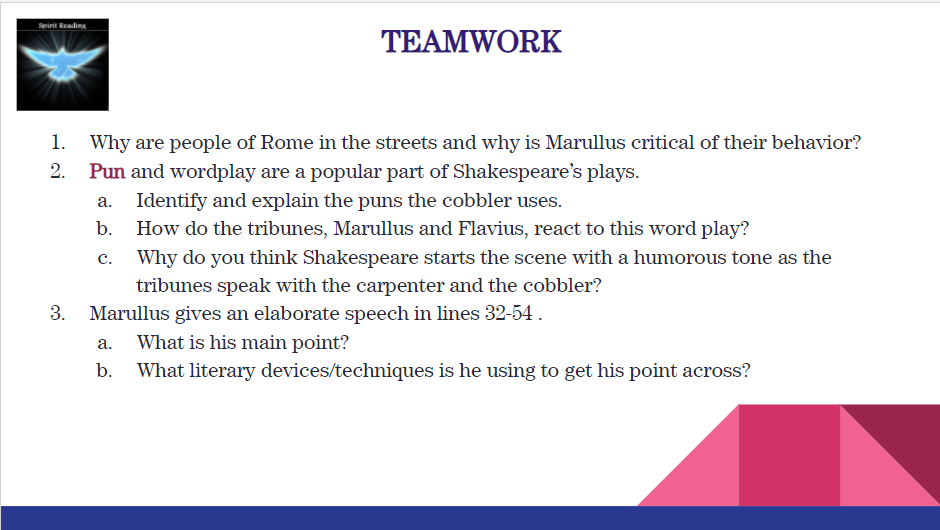


Our team came up with the following answers to those questions :

  1. The people of Rome are in the streets because they are celebrating the return of Caesar. Marullus is critical of their behavior because he feels as though Caesar doesn’t deserve the  praise that he’s getting especially after how he’s treated others.


    1. A pun that the cobbler uses is: “A trade, sir, that, I hope, I may use with a safe conscience; which is, indeed, sir, a mender of bad soles.” By this, he can refer to both the soles of shoes (a cobbler is a person who fixes shoes), as well as souls. Since this is meant to be spoken and not read, the audience wouldn’t be able to tell which one he was referring to.

    2. The tribunes do not take it lightly and do not like the jokes, and just want him to reveal his job.

    3. Shakespeare uses juxtaposition, because soon after this joke, the situation gets tense as they get mad about Caesar killing Pompey.

  2.  

    1. Marullus’ main point is that Caesar should not receive this much praise since he killed Pompey.

    2. He is using repetition and personification so that he can emphasize his ideas more.

    3. Anaphora creates emphasis and it makes the tone more accusatory, basically blaming or shaming them.

  3. They plan to remove all the trophies and items that honor Caesar.

    1. The tribunes most likely favored Pompey and the commonors favored Caesar, which is shown by the two groups expressing their support for their respective leader.


Finally, we discussed with the entire class, and we all mostly agreed with each other on all the points, while adding on with comments that furthered the idea we believed. 


Reflection:

Today, we learned about how Caesar was portrayed to the people of Rome and what different people thought about him. I learned about how the commoners favored him while the tribunals disliked him for killing Pompey, and I’m excited to read more of the play. I also learned that Shakespeare used a lot of figurative language like juxtaposition and anaphora. What I learned today was helpful because it furthered my understanding of history.  Even though the play is the summarized history that was most likely not completely factual, it lets me see how people in Shakespeare’s time thought of the history of Rome and Caesar’s life. I can use what I learned about anaphora and juxtaposition to better my creative writing and use more sophisticated language. The information from the play can be used in other classes like APWH as background knowledge when learning about history from the time of Caesar or Shakespeare.


Wednesday, December 1, 2021

Blogger #28 - Thomas Vayos - Period 8 - 12/1/2021

 December 1st was the first day we switched from covering William Golding’s The Lord of the Flies to Shakespeare’s Macbeth. However, we did not cover any of the pages, but instead examined the context behind the story through 3 important recurring themes, achieving the Aim of Familiarizing Ourselves with Shakespeare’s Macbeth.


The first theme that is introduced is superstition with the Whole Class Discussion, asking “Do You Consider Yourself to be a Superstitious Person? Why/why not?” All responses were “no,” but beginning with Elizabeth’s response, people began to answer that they may have incorporated superstitious beliefs into their habits, because they were instilled by their parents.

When one student seems uncertain of their answer, Ms. Peterson asks another question: Why do we say God Bless You? Among several answers (some which were about the plague, others which brought up the interesting point that in other languages “God Bless You” is replaced with “I wish you well.”) Ms. Peterson’s answer is that the blessing was to prevent the devil from stealing away the person’s soul, and was incorporated as a tradition throughout the centuries, with most of its superstitious background being stripped. She concludes that Superstitious Beliefs are All Around Us, Even If We Don’t Realize It.

Superstition is the first of the three themes.


It moves onto Shakespeare’s life, with the undertone of paranoia -- it is emphasized that Shakespeare possessed a deep fear of having his works stolen. There are also some circumstances which otherwise wouldn’t be out of the ordinary, but when compared with the future slides clearly act as an introduction to the second theme: those being the included facts that all of his children never lived to see adulthood, and that he himself died on his birthday.  Strange circumstances around death incur the fear of the thought that it was something at play beyond just coincidence, and therefore Curses are our second theme. 

It is explained how his remains are cursed in an Epithet, which cannot be said for certain was written by him. It concludes:

“And curst he be that move my bones.”

It is then asked what the class thinks of Shakespeare. In line with the responses from the question of whether or not they were superstitious themselves, most students saw Shakespeare as an absolute nut, describing him as paranoid.


The conversation shifts from Shakespeare himself to the work of his that we are reading, Macbeth, but without disclosing any of the writing itself. Instead, it focuses on the writing of the play: Macbeth was made anywhere between 1603 and 1606 and was one of Shakespeare’s shortest tragedies, written as tribute to King James I after Elizabeth, who he had previously written for, was deposed.

Much like Shakespeare, King James I was also quite loony. Holding the title of the Royal Witch Hunter, King James I was a protestant who believed that witches and demons walked freely alongside man, sent by God to test his faith & conviction. The zealotry in his beliefs comes from an encounter he had with witches before, where several women went out to sea on sieves to sink King James I’s vessel. When this story was questioned, one of the women had seemingly divined what King James I had said behind closed doors to Princess Anne on their wedding night.

Divination and sorcery are our third theme. Although outwardly the weakest theme, Ms. Peterson explains further that we should expect the supernatural to play an important role in Macbeth.


In contrast, the theme of Curses is prominent within the backstory of the play. It is revealed that Macbeth had been cursed for over 400 years, cursed by practicing witches who had their ordeals exposed with the exposure of Hecate, their goddess.

A number of Superstitions arise from the idea of the play being cursed, such as having to spin thrice around, say a curse-word (other kind), and then spit on the ground, only to then quote Hamlet “Thrice around the circle bound, evil sinks into the ground.”

Much like earlier, the idea that the play is cursed is established with a number of events that pile one on top of the other, until it no longer seems like just coincidence. Several incidents where the actors would die either from illness or from other means that were subtly off, like a blunt dagger being exchanged for a very real one. These circumstances number 10 in total, beginning with the very first performance, where Macbeth’s intended actor got fatally ill, and lasting until 1972, with several robberies and fires.

We are left to ponder if we will be the next victims in this long list of tragedies. 


This is where the conversation changes yet again, away from the background behind the play, and more towards the dynamic of the production and writing.

It is discussed that, when in a play:

  • Only men can perform, as women were too emotionally weak

    • Young boys or effeminate men took their place

  • Costumes were one of the most valuable assets for any acting stage.

The universality of plays is also discussed with The Globe Theatre. Ms. Peterson asserts that this was entertainment for everyone, from the lowest of peasants to the highest of kings. The scale of The Globe Theatre, with several sections of nosebleeds & a lower standing section, emphasizes the popularity of plays.

Expectations Ms. Peterson sets for us that Macbeth will hold a great deal of the Three Themes: Superstition, Curses, & The Supernatural, as well as more human themes of tyranny, cruelty, and ambition running free.


Blogger #27 - Sofya Reshetnikova - Period 3 - 12/01/21


Aim: How can we familiarize ourselves with Shakespeare's Macbeth?


Do Now:

As a class, we all discussed whether or not we believe ourselves to be superstitious. Some people said no while other explained their superstitions. One person brought up the difference between religion and superstition and overall we had a great discussion full of multiple opinions and points of view.

Shakespeare

Today we prepared ourselves for our reading of Macbeth by gaining a little bit of background knowledge on Shakespeare.

He was born in 1563 in England and he actually began his career as an actor. Despite this, he’s written 36-38 plays, 154 sonnets, and 2 long narrative poems. Shakespeare was terrified that someone would steal his work so he did not distribute original copies and the actors were only given their lines. Everything we have today was written down by the audience who was watching the play. None of Shakespeare’s plays were officially published throughout his life and he passed away on April 23, 1616.

It is believed that Shakespeare’s remains are cursed. According to some, he was afraid that his remains would be stolen and he placed a curse on himself. This curse was quite effective for his remains have not been touched since he was buried.

Below is a photograph of Shakespeare's grave.


Discussion

After gaining some insight into who Shakespeare was, the class discussed our impressions of him. Some said they find him quite peculiar while others pointed out how paranoid he was. Overall, we all got a similar impression of him, and after this discussion, we proceeded with our lesson.

Macbeth


After the discussion, we gained some more insight into Macbeth, both the play and the king. We discussed the important figures in the play, including Macbeth. We learn that Macbeth was written for King James I, and it was Shakespeare’s shortest tragedy. Throughout the play we see the common belief of witches and daemons. King James was quite superstitious and believed that witches and daemons were sent by God to test mankind. In fact, King James was the nation's leading witch hunter! After catching some witches who sunk his ship, King James wrote the “bible” of witch-hunters. Witches were believed to be women who had supernatural powers. They were accused of anything from souring milk to killing cattle and they were blamed for bad crops and poor weather.

The Curse of Macbeth

It is believed that the play Macbeth was cursed by witches who were upset that their secrets were being shown on stage. They placed and eternal curse on the play and to this day, the play remains cursed. Some examples of the curse include the boy who played Lady Macbeth suddenly died from sickness and William Shakespeare had to play Lady Macbeth himself, and actor playing Macbeth substituted the blunt dagger for a real one and killed his co-actor, in 1849, 31 people were trampled to death during a riot that broke out, and in 1934, a British actor turned mute on stage and his replacement got extremely ill and had to be hospitalized.

The Play

In the play only men were allowed to perform as women were believed to be too weak in emotion to act and instead, boys and effeminate men played the women. Costumes were the company’s most valuable asset and they were often bought in London or donated by courtiers.

The Globe Theater

The Globe Theater was an open air theater that no internal lighting so plays had to be performed during the day. The upper class could buy seated tickets while the lower class bought cheap standing tickets. Many playwrights had nowhere to perform their plays and so they turned a barn into a theatre, and then the Puritans burned it down, and then the Globe was build but it also burned down and it was rebuilt and then it burned yet again.

Expectations

Following our discussions about the globe, we got some expectations for Macbeth. These include supernatural occurrences, tyranny and cruelty, and unchecked ambition.

Macbeth Referenced in Modern Media

Finally, we discussed common references of Macbeth in modern media. My favorite example was from Harry Potter and the Prisoner of Azkaban, “Double, Double, Toil and Trouble”

Blogger #11- Zainub Hashmi- Period 2- 12/1/2021

 Today’s class was a catch up of the previous lesson(4 JC: I  .ii [Part 2])


Aim: How  has Shakespeare’s presentation of characters provided both clarity and context through characterization (meaning what they say of themselves and others)?


We started by looking at the teamwork questions provided on the powerpoint and finished what was left from the previous day.


The questions discussed and answers:

  1. What is meant by Cassius in lines 142-148?

-(Sophia) In lines 142-148 Cassius is comparing Caesar to a giant who steps on everyone. He means that Caesar does not deserve this attention and his glory is being blown out of proportion.


  1. How does Brutus respond to Cassius? (lns. 171-184)

-(Jessy) Brutus had responded to Cassius by saying that he is not jealous of Caesar. He just believed he did not deserve all that he was receiving.


  1. Interpret Caesar’s observations of Cassius in lines 202-224. 

-(Tiffany) He is paying attention and is perceptive in the red flags of his people even though he has a lot of power

  1. Assess Casca’s retelling of the “crown rejection” scene (lns. 231-299). According to Casca, what took place?

-(Aaron) According to Casca, Caesar rejecting the crown is a way to get popular with the people and get them to like him. He believes that he wants to accept but will not help his image.


a.Then, based on his dialogue and descriptions, make inferences on how he feels about Caesar. How does his dialogue with Cassius and Brutus differ from how he presents himself in the beginning of the scene in front of Caesar and his entourage?

-(Tiffany)Based on his dialogue and descriptions we see that he is not loyal to Caesar. In front of Caesar he depicts himself as a loyal man but he talks about him and his actions behind his back. He presents himself as two faced and we see that he is more honest in front of Cassius and Brutus while he puts up a front for Julius.


Interpret and summarize Cassius’ plan revealed in his final speech? (lns. 320-334)

- (Sophia) Cassius’s plans to send multiple letters to Brutus in different handwriting so it looks like people support him. This shows that Cassius is passionate about his goal to destroy the reputation of Caesar. It also shows how deep rooted his jealousy is.

  1. What tools of persuasion does Cassius use throughout the scene to further his cause?

-(Zainub)Throughout the scene Cassius uses flattery and tries to portray that Caesar is a bad person and he is better and more deserving than him. He is also using Brutus’ ego to get the support he needs to carry out his plans.

  1. Do you feel Cassius’ judgment of Caesar is fair? Why or why not?

- (Zainub)Cassius' judgement of Caesar is fair when you look at the way he acted when he was supposed to receive the crown. It seems it becomes more of a struggle to reject it and this shows that he is in it for personal gain

Summary of Cassius’ plan : https://study.com/academy/lesson/julius-caesar-betrayal-quotes-meaning-analysis.html

  1. Is his assessment based solely on Caesar’s political ability or something else?

-(Sophia) It seems there is less of a hatred for Caesar because of his political ability but more for the glory he is getting and his ego. It shows their Jealousy

In addition, we dove deeper into the mindset and traits of the four main characters with our teams and had a class discussion. Some traits we agreed on were:

Vocabulary:

Soliloquy: a device often used in drama when a character speaks to himself or herself, relating thoughts and feelings, thereby also sharing them with the audience. Other characters, however, are not aware of what is being said.

Flattery: Excessive and insincere praise, given especially to further one's own interests.

Veni vidi vici: A Latin phrase that is well known because of Julius caesar. It translates to “I came, I saw, I conquered.”

-An additional video about the phrase: https://youtu.be/gb7W5K51-iU


Reflection:

Today’s lesson was taught to us to help us realize the true motives of Cassius, Brutus, Casca, Antony, and Julius Caesar. It gave up an in depth understanding of Scene I act II which will help further our understanding of the text to come. We learned about this to become better readers and master the perception of plays and other literary works. Learning about the motives of these characters has not only aided in developing our comprehension. The information acquired through this analysis also helps us learn about people and their actions in the real world. It teaches us how to read people and become more perceptive and observative. This information can be used to help us create real bonds with others and realize when people are different from what they portray themselves to be.