Sunday, May 2, 2021

Blogger #12- Sahil Gandhi- Period 7- 4/28/21- Day C

 Aim: How does Homer’s invocation establish tone for the beginning of the Odyssey?

Do Now: “How do you become inspired? Where does it originate?”


Personally, inspiration comes from a variety of sources that each possess stimulative qualities, with the importance of each one depending on the individual. Regardless of individuality, many find inspiration from others and objects, such as their family, friends/role models, music, art, and literature. 


Many of my peers in my class also provided thoughtful explanations for where inspiration comes from. In particular, one interesting response that stood out to me came from Joanne; to her, inspiration emerges from things such as music, art, and literature, and it reminded me of my own definition of inspiration. Another one that I remember is a different classmate mentioning personal experiences, which I initially hadn’t perceived as being inspirational.


Today’s Lesson:

Before proceeding with the lesson, we also finalized our class teams’ name changes. As one of the pointmasters, it would be up to us and the managers to ensure that every team has their name updated in any instances where their old respective team names were recorded. 

Many teams decided on using names that revolved around common themes in Greek mythology, utilizing concepts such as discord, prophecies, mythological creatures, and cities  among other things. My team went with a more whimsical approach and ended up adopting the name Kittens of Discord.’


Today, according to Mrs. Peterson, would also signify a turning point in the year. Although it is the end of April the Poem Anthology project is over, classes are not going to become any easier. On the contrary, this is when literature will become serious; complex Greek literature, more intensive lessons per cycle, more homework to fit with the unconventional schedule, preparing to become sophomores, and much more. This seems like a daunting task at first, but I believe that if we put our minds to it and work hard towards our goals, this unit on Greek mythology is going to be an enjoyable experience.
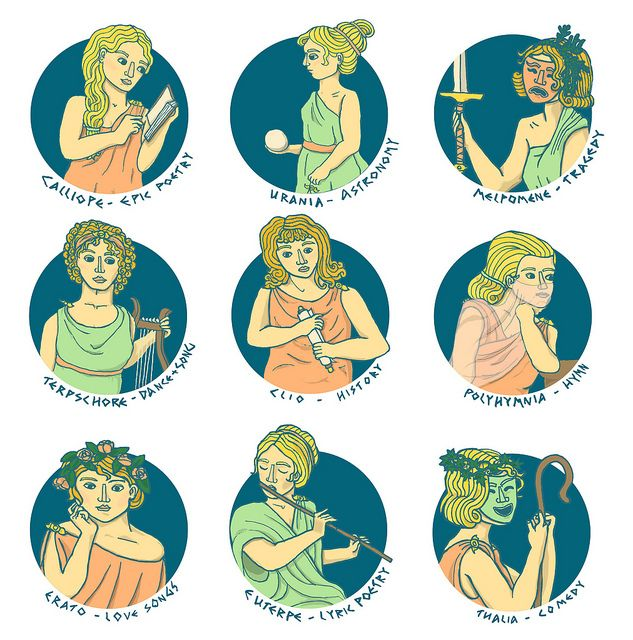

The Nine Muses:

A muse is an inspiration for poets, musicians, and other types of artists. In particular, Greek mythology identified nine primary Muses, goddesses of art, literature, and science.

This is also where we are introduced to Homer’s invocation. Homer’s invocation pays homage to the Nine Muses and collectively Ancient Greek culture as a whole. We watched a video on the Nine Muses as well, which was informative and gave us further insight on them. 

https://www.youtube.com/watch?v=ORKCWfbrY8k

Homer’s Invocation:

After learning about the Nine Muses present in Greek mythology, we moved on to Homer’s invocation, which was mentioned previously. We read Homer’s invocation as a class (link: https://drive.google.com/file/d/1s-NNLrpTeNKGXaJYMqGKo_QPZ57DMIx0/view?usp=sharing) and in essence, Homer called upon the daughter of Zeus and praised her, asking that she bequeath upon him the ability to masterfully narrate the story of Odysseus’s journey home to Ithaca from Troy.


Following this, we discussed as a class 3 important questions regarding Homer’s invocation. Provided are the questions and my answers to each one.


  1. What is your opinion of Odysseus so far after hearing Homer's invocation to the muses and learning about the Trojan War?


My opinion of Odysseus after hearing Homer’s invocation to the muses and learning about the Trojan War was that he was a man of great discipline, charisma, and strength, capable of razing a city as grand as Troy to the ground and making the arduous decade-long journey back home.

  1. How does Homer maintain the audience’s interest in the story, knowing that the audience is aware of the outcome from the very beginning?


Homer maintains the audience’s interest in the story regardless of the fact that the audience knew the outcome from the start through often exaggerated diction that portrays Odysseus strength and character.

  1. What does the invocation of the Muse in the opening lines clarify about Odysseus’ culpability (responsibility for a fault or wrong; blame) during his voyage home?


The invocation of the Muse in the opening lines imply that Odysseus endured through a lot of struggles following the fall of Troy. Through the author’s word choice (words like “harried” or “contending” we can comprehend the idea that Odysseus’ struggles were numerous even after his primary goal was achieved.


Anticipation Guide:

We participated in an anticipation guide in which we had to state our opinions on a variety of topics, but it was clear that the questionnaire revolved around the Odyssey and the questions were related to aspects of the epics.


At the very end of the quiz, we had to construct a paragraph that would provide further explanation for any single answer inputted previously in the quiz. My response was to the question of whether intelligence was more important than strength and it was:

“Intelligence is equally as important as strength, and one does not overpower the other. Proof of this can be seen through the stories of the Trojan War. The Trojan War came to end thanks to the ingenious idea of the Trojan horse; disguising a legion of soldiers within a large wooden horse gifted to Troy. However, if the soldiers didn't have the strength necessary to hold out for so long and fight with valor, they wouldn't have had the chance to undertake a plan as intricate as the Trojan horse.”


Aim: How does “Sailing From Troy” and “The Lotus Eaters” (Book IX) establish Odysseus’ role as a leader?


The Next Lesson:

After completing the Anticipation Guide, we moved on to the second lesson, which started with another discussion, with the question being, “Consider the fact that Odysseus has been trying to return to his home in Ithaca for 10 years. Imagine being away from home for that long. What would you miss the most and why? Why do we have sayings like the ones below?




Lixiang said that if he was in that position, he’d miss his family and the phrases “home sweet home” and “there’s no place like home” exist for a reason. Family is irreplaceable and no matter what happens in the end they’re still your family. Tempestt added on to that and mentioned “home is where the heart is.” He also said that he’d also miss basic things like a bed or showering, and that they all related because the family is like home. Many other students added to this idea. 


My response to these questions was that I’d miss my home, my family, my friends, and what life meant to me. One statement I remember vividly was “Absence makes the heart grow fonder.” This was also one of the questions presented in the anticipation quiz.


Characterization:

Characterization is an author’s distinct method of defining the aspects of a character, specifically things such as personality or experience. It often differs from author to author, and it’s one of the most important features of fiction and mythology. It can be divided into two different categories of characterization, for which the definitions are provided below.

  • Direct Characterization: The author makes direct statements about the character (can be revealed through a narrator or through another character in the story). The author TELLS the reader what they want them to know.

  • Indirect Characterization: indirectly stated from character’s actions, choices they make, dialogue/relationships with others, thoughts, feelings. The author SHOWS the reader what they want them to know.


Here is also a video that gives a brief summary of characterization: https://www.youtube.com/watch?v=HCshdu8loDo


Most people use direct characterization because it’s easier and there’s no reading between the lines; indirect characterization is a lot more tricky. In the Odyssey, both forms of characterization are implemented multiple times. As such, we have to think about the author’s purpose and what they intended to convey through both forms. 


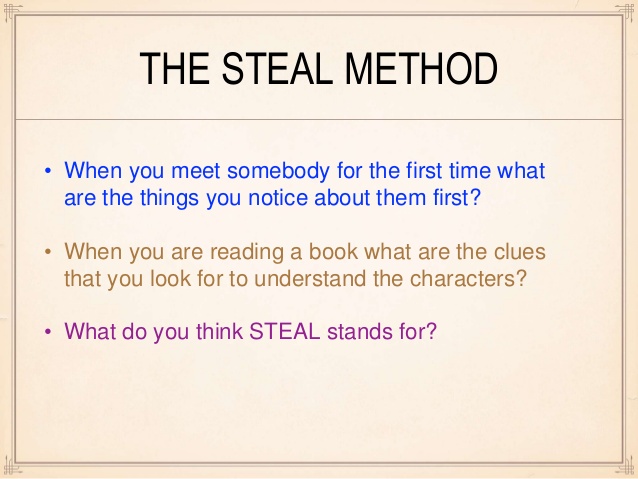
However, to help us identify indirect characterization, we learned a strategy called S.T.E.A.L. When you’re working with indirect characterization, you’re actually asking yourself the type of questions that constitute the letters in S.T.E.A.L.


  • SPEECH - What does the character say? How does the character speak?

  • THOUGHTS - What is revealed through the character’s private thoughts and feelings?

  • EFFECTS - What is revealed through the character’s effect on other people? How do other characters feel or behave in reaction to the character?

  • ACTIONS - What does the character do? How does the character behave?

  • LOOKS - What does the character look like? How does the character dress?


After going over STEAL we read Sailing from Troy. It was about Odysseus departing from the Goddess Calypso’s island and landing in a land known as Phaecia, where the ruler is willing to provide Odysseus with resources to get back home given that he tells him of his adventures in Troy. We were also supposed to read and discuss about Lotus Eaters, but we ran out of time and this was instead assigned for homework.

Reflection:

Today we read about Homer’s invocation, and learned about various topics such as muses (the Nine Muses), what inspiration is, direct and indirect characterization, and methods to tackle them. The lengthy lesson of this cycle was definitely a change of pace, and I definitely didn’t anticipate to learn that much from this lesson because of time constraints. However, as it turns out, this was an invaluable lesson that I staunchly believe will play a crucial role in later lessons as we extend our reach throughout the world of Greek epics. I can say with confidence that I definitely noticed how direct and indirect characterization and the associated method of S.T.E.A.L. are and will be of critical importance in the near future. I also believe that for the same reasons stated above, there were good reasons why we had this lesson. This is because when studying this genre of literature, it is clear how convoluted and tedious ancient Greek epics often tend to be, and knowing about how to dissect the numerous verses and many characters presented will be more important than ever. I think this lesson was a great opening segment into properly understanding and taking apart ancient Greek literature and as mentioned previously, will play a pivotal role in comprehending the structures of the Odyssey.

Blogger #10- Miki Chiu- Period 7- 4/28/21- Day C

 3 RL SP: Odyssey: Homer’s Invocation


Aim: How does Homer's invocation establish tone for the beginning of the Odyssey?

After finishing the poem anthology project and learning about poems, we will be starting on the Odyssey. Ms. Peterson addresses that this is the starting point of where things are going to change and begin to get harder to prepare us for sophomore year. We usually do most of our work in class, but the Odyssey is structured differently. Ms. Peterson also reminds us of how teachers are going to give you a syllabus and not remind you of homework that is due anymore. Now it is our responsibility to check syllabus regularly. Today’s lessons include homework which is reading and taking notes. A majority of it is reading stuff asynchronously because it’s our responsibility as students to be prepared. 


Do Now: CLASS DISCUSSION

How do you become inspired? Where does it originate?


Some of my classmates' answers are as follows:

Sophia said inspiration comes from the people around you. 

Bernice said inspiration comes from personal experience. 

Joanne said inspiration comes from music, books, literature or art. 

I think inspiration comes from people you idolize or people around you. 

Then, Ms. Peterson points out that everyone draws inspiration from different places or people.


After discussing the do now, we have to make a new team name inspired by the Odyssey. My team's old name was The Spirits which was inspired by the Alchemist and has now changed to The Wind Walkers. 


We then moved on to talk about the nine muses and how they served as an inspiration for writers and artists and watched a YouTube video discussing how they were inspirational goddesses. Here is the link https://youtu.be/ORKCWfbrY8k. 


Next, we conversed about the invocation of the muse. What is an invocation? Look it up. When I used my device to look up the work “invoke”, the definition I got was “to cite or appeal to (someone or something) as an authority for an action or in support of an argument”. 


Group Discussion 

As a class, we read Homer’s Invocation, lines 1-17 and discuss the three following questions.

  1. What is your opinion of Odysseus so far after hearing Homer's invocation to the muses and learning about the Trojan War? Oscar says he’s being smart and courageous. 

  2. How does Homer maintain the audience’s interest in the story, knowing that the audience is aware of the outcome from the very beginning?   Homer maintained the audience's attention by using poetic language and metrical phrases.

  3. What does the invocation of the Muse in the opening lines clarify about Odysseus’ culpability (responsibility for a fault or wrong; blame) during his voyage home? Wilson Wang says he tries to save his men but the men didn’t come back bc of foolishness. His men only perished because they ate the cattle of the sun god. Joanne says it’s making reference to lord helios and the god of thunder and it's like a teaser in the invocation because it is also revealed that his men's foolishness led to their demise.


We did an anticipation guide at the end of the lesson to input our opinions on various quotes. At the end of the google form, we had to write a paragraph stating what we strongly opinionated against and I disagree with the leaders being responsible for the people they supervise, because although that should be true, most people will disobey or rebel against the rules and cause chaos.


4 RL SP: Odyssey: Sailing from Troy & Lotus Eaters


Aim: How does “Sailing From Troy” and “The Lotus Eaters” (Book IX) establish Odysseus’ role as a leader?


This cycle, we had to fit two lessons into one cycle to speed up the pace. 


Do Now: Consider the fact that Odysseus has been trying to return to

his home in Ithaca for 10 years. Imagine being away from your home for that long. 

1) What would you miss the most and why? 

Well, I would miss my family the most because they’ve been around me since I was born and I love them.

2) Why do we have sayings like the ones below? 

We have sayings like that because although there can always be a place similar to home, there's no place that can replace it.


Some of my classmates' answers are as follows:

Lixiang said he will miss his family the most and that most people will miss family the most because you can never replace the original family and there’s only one family you can have and that’s at home. 

Tempestt will miss his family but besides that he would miss being able to shower and having a bed. He said that there’s a saying that “home is where the heart is” and how family is the home and you don’t really need a house to call it home. 

Natalie will miss her bed the most. 

Alma would miss her family and miss having the feeling that she’s surrounded by ppl she loves. 


Characterization 

The method by which an author creates the personality and appearance of their character.

Direct Characterization: The author makes direct statements about the character (can be revealed through a narrator or through another character in the story). The author TELLS the reader what they want them to know.

Indirect Characterization: indirectly stated from character's actions, choices they make, dialogue/relationships with others, thoughts, feelings. The author SHOWS the reader what they want them to know.


We can use the STEAL method for Indirect Characterization. 

■ Speech

■ Thoughts

■ Effect on others toward the

character.

■ Actions

■ Looks

For a more specific view on STEAL, here is the following:

■ SPEECH - What does the character say?

How does the character speak?

■ THOUGHTS - What is revealed through the character’s private thoughts and

feelings?

■ EFFECTS - What is revealed through the character’s

effect on other people?

How do other characters feel or behave in reaction to the character?

■ ACTIONS - What does the character do?

How does the character behave?

■ LOOKS - What does the character look like? How does the character dress?


Then, we watch a YouTube video explaining characterization using the Disney movie, Frozen. Here is the link https://youtu.be/-ZnD0AGqQ7I. 


We continue to read “Sailing from Troy” lines 18-69 and answer the question:


Keep in mind that the Odyssey is the account of Odysseus' ten year journey back home to Ithaca. He misses his family and home; therefore, we will often find connections to this throughout the poem.

Identify lines in which Odysseus talks about his home in Ithaca.

➢ How does he feel about it? (Specific lines/evidence that describe these feelings)


However, we did not have enough time to finish answering the question and finish the lesson. Ms. Peterson also informs us that unlike the English language, where the letter e is not pronounced at the end of a word, it should be pronounced in the Greek language.


We were supposed to read “Lotus Eaters” lines 70-105 and answer the following questions :

  1. What kind of world do you think the Lotus Eaters live in? ➢ Describe the type of lifestyle it is?

    1. What do you think Homer is implying about this lifestyle/world?

  2. How does The Odyssey characterize the land of the Lotus-eaters as a veritable

    1. (real or genuine) paradise? And, why, then, is this land seen by Odysseus and others as negative, and something from which to escape? What do you think is wrong with such a place, if anything?

  3. Consider the kind of leader Odysseus appears to be in "Sailing from Troy."

➢ How do his leadership abilities compare to how he is in "The Lotus Eaters?" 

➢ Has your opinion of him changed? Why/Why not?

➢ Why do you think these events are important to understanding Odysseus' character?

  1. In your notes, create a group list of the key events in "The Lotus Eaters."


Reflection

This cycle I learned more about the Odyssey and Greek mythology. My knowledge of more terms has expanded as well as knowing more about where poets get inspiration from and how people get inspired. I read more about the Odyssey by reading Homer’s Invocation and etc. I also learned more about characterization which is very important in literature. I renewed my knowledge of the STEAL method as well as characterization itself. I learned all of this to prepare myself for sophomore year, and just to have more knowledge of Greek mythology and literature techniques. I will use what I have learned in the future when I’m in my senior year of high school or when I’m in my first year of college. This will help me understand more passages and annotate better.


Friday, April 30, 2021

Blogger #12, Alexander Handal, Period 5, 4/27/21, Day B

 3 RL SP Odyssey: Homer’s Invocation

Aim: How does Homer’s invocation establish tone for the beginning of the Odyssey.

Do Now: Class Discussion 


“How do you become inspired? Where does it originate?


I said what inspires me is to do better than the people around me, and to please the people around me like my family. Some of my classmates said other things like listening to music, playing sports, and seeing different things in nature.


After going over the class discussion question, Mrs. Peterson put us into groups so we could change our group name to something that had to do with The Odyssey. My groups changed our  name to the fairest because of the 3 “Fairest” goddesses that fought over the golden apple.


The Nine Muses: 

After going over our name changes, we started the lesson out by going over the nine muses and what role each one of them plays. We learned that each muse was an inspiration for poets and artists, and some of their different roles were comedy and dancing.


https://www.youtube.com/watch?v=ORKCWfbrY8k This is the video we watched about the nine muses.


After learning about the Muses we read about the word invoke and its definition, and how Homer uses it in lines 1-17 in the Odyssey. In the Odyssey, Homer invokes the Muses because he wants to tell the story of Odysseus, and he can only do that if he is granted it from the Muses. We then answered some questions about lines 1-17 to help us further our understanding of The Odyssey.

Homer’s Invocation     This is the link to lines 1-17


  1. What is your opinion of Odysseus so far after hearing Homer's invocation to the muses and learning about the Trojan War?

My opinion of Odysseus is that he is very selfless and prioritizes others above himself. In the end though he is still a human and has human faults like arrogance. 


  1. How does Homer maintain the audience’s interest in the story, knowing that the audience is aware of the outcome from the very beginning?

He maintains the audience's interest because he uses different literary devices that keep the reader engaged and makes them want to keep reading.  


  1. What does the invocation of the Muse in the opening lines clarify about Odysseus’ culpability (responsibility for a fault or wrong; blame) during his voyage home?

The invocation of the Muse clarifies Odysseus's culpability because it says Odysseus couldn’t save his crew after they killed and feasted on Helios's cattle.


4 RL SP: Odyssey: Sailing from Troy & Lotus Eaters


Today’s lesson was a double lesson in which the 2nd lesson was a continuation of the 1st lesson.


Aim: How does “Sailing From Troy” and “The Lotus Eaters” (Book IX) establish Odysseus’ role as a leader?


We started out by going over the two do now questions and how they related to Odysseus and his journey home. Mrs. Peterson then asked us what would we feel like if we were away from home for a long amount of time.

  1. What would you miss the most and why?

What my class came up with for what we miss the most if we were away from home for a long time is family, friends, your bed, familiar surroundings, and a home cooked meal. You won’t know how much you miss these things until you are actually away from home.

  1. Why do we have sayings like the ones below?


We have these saying because they are so true, and once we get home there is nothing like it. I could say this from personal experience, even when i'm having a good time on vacation I still sometimes miss just staying home and relaxing on the couch or going to the park to hang out with my friends.


We then quickly went over the STEAL method and how it could help us with our characterization. We didn't go over it in depth because of the lack of time, so Mrs. Peterson provided a link for us to watch that would help us.

Characterization Lesson | Using Disney's Frozen [4:55]


  • SPEECH - What does the character say? 

How does the character speak?

  • THOUGHTS - What is revealed through the 

character’s private thoughts and feelings?

  • EFFECTS - What is revealed through the character’s 

effect on other people? 

How do other characters feel or behave in reaction to the character?

  • ACTIONS - What does the character do? 

How does the character behave?

  • LOOKS - What does the character look like? 

How does the character dress?


We then continued our reading from the other lesson and read pages 18-69 from sailing from “Sailing from Troy”. The link is provided right here. Sailing from Troy


Like how we did in lines 1-17 we then answered some questions in our groups about the lines we just read, and we went over them as a class.


GROUP WORK

  1. Keep in mind that the Odyssey is the account of Odysseus' ten year journey back home to Ithaca. He misses his family and home; therefore, we will often find connections to this throughout the poem.  


Identify lines in which Odysseus talks about his home in Ithaca.  

  • How does he feel about it?  (Specific lines/evidence that describe these feelings)  

He is definitely homesick about Ithaca. He loves his home more than anything else and the one thing he wants to do is to go back and see his family and home. The text states “I shall not see on Earth a place more dear.” This shows how dear his home is to him, and he just wants to get back.


After reading these lines and answering the questions, we continue the story with lines 70-105. This section of “The Odyssey'' was about the Lotus eaters and how Odysseu’s crew almost got stranded on the island with them. The link to these lines is right here. Lotus Eaters. Similar to the other parts of the story we read, we then answered some questions about these lines.


GROUP WORK


  1. What kind of world do you think the Lotus Eaters live in?

  • Describe the type of lifestyle it is?

I think they live in a world that is a paradise where they forget about all their memories like home or family.


  1. What do you think Homer is implying about this lifestyle/world?

    1. How does The Odyssey characterize the land of the Lotus-eaters as a veritable (real or genuine) paradise?  And, why, then, is this land seen by Odysseus and others as negative, and something from which to escape?  What do you think is wrong with such a place, if anything?

This is seen as negative because those people just want to get home more than others, and they would rather see family and friends before living in this paradise.


  1. Consider the kind of leader Odysseus appears to be in "Sailing from Troy."

  • How do his leadership abilities compare to how he is in "The Lotus Eaters?"

  • Has your opinion of him changed? Why/Why not?

  • Why do you think these events are important to understanding Odysseus' character?

Odysseus changes as a leader throughout the book. In “Sailing from Troy” he displays a weak leader by plundering cities, but in “The Lotus Eaters” he acts like a strong leader by displaying care for his men. My opinion changes because he changed from a weak person who doesn’t care about anything to someone who does care for his men and crew. These events are important because they show change in his character development. They show a bad person changing into a strong leader.

  1. In your notes, create a group list of the key events in "The Lotus Eaters."

-See’s some of his crew get “hypnotized” by the Lotus flowers

-Displays leadership skills by caring for his crew and wanting the best for them.


Reflection: These two lessons that we went through today were jammed packed with all sorts of new and interesting information. We learned so much about different aspects of “The Odyssey” and of Greek mythology in general. The main gist of the lesson was learning about “The Odyssey” and how different things like invocations and characterization are included in the story. We learned about Greek mythology with the nine Muses and how impactful they were on peoples lives at the time. This lesson was a great stepping stone for me to help learn more about Greek mythology and understand it’s culture and daily life better. This lesson will also be really useful as background knowledge of “The Odyssey” because we have 18 lessons in total that have to do with “The Odyssey”. The connections from this lesson to others will help me perceive them and understand them in a whole new matter.