Sunday, November 8, 2020

Blogger #2, Huixin Chen (Tracy), Period 9, 11/6/2020, Day C Freshman 2021

Aim: How can we use the poem, “This is Just to Say” by William Carlos Williams as inspiration for our own poems? 


Before the lesson:

Before the class started attempting the do now and analyzing the poems, we were briefly reminded of the blogging cycle and the blogging sheet. There are three students who would be blogging per cycle and in charge of capturing the lesson as best as possible. This would include the discussions that take place, the aim, the do now, and activities that happen throughout the class. It is also necessary to be mindful of the formatting, making sure it’s clean and easy to read so that the blogmasters wouldn’t have to do any “clean-ups” or make any corrections as they are not your editors. The blogmasters are only responsible for posting the work you have provided onto the blog for worldwide audiences. If you are taking notes as the lesson goes on, about 90% of the blog should have been completed throughout the period. The other 10% would include your reflection (How has this helped me? What am I learning from this? How am I going to apply this into the future), links, and pictures that would be helpful in understanding the materials. The class was then provided an example of a blog from the previous year. 


Example of a blog: https://msjpetersonsblog.blogspot.com/2020/06/blog-55-steven-mantello-period-7-6132020.html


A reminder that Parent-Teacher Conferences are coming up on 11/13/20.


Do Now: Think/Pair/Share. Describe a time when you or someone you know did something that was “technically wrong” and you should have felt sorry for it but you didn’t? 


Before students started sharing their personal experiences, Ms. Peterson mentions that after hearing from a lot of classes, she notes that this particular situation happens a lot with siblings. The discussion first starts with a student sharing about how they had borrowed their sister’s clothing without asking. They knew they were in the wrong but did not feel sorry in the end. Ms. Peterson then shares that she’s had a colleague who’s dealt with a similar situation. She also mentions a story about how she was falsely framed for breaking something she has not. The “culprit” was then laughing and pointing fingers because they had known that Ms. Peterson was not the one in the wrong. After the discussion was over, the class would keep these ideas and situations in mind as the lesson continues.


Next, the class was introduced to a poem called “This Is Just To Say” by William Carlos Williams. This poem was published in 1934. The class read the poem together by utilizing the method of Spirit reading.


“This Is Just To Say” by William Carlos:

https://www.poetryfoundation.org/poems/56159/this-is-just-to-say


The class would then learn about the coordinating conjunction we know as “but.” Even though the word itself was not utilized in the poem, the word could be implied or inferred to some extent. When you are to apologize to someone, and you follow up with the word but, it shows as a sort of justification that what you feel you did was “right” and that you are not truly sorry for what you have done. This example can be applied as context to the poem because the author is saying that he has eaten the plums but then he mentions the words “forgive me” and goes on to give an explanation as to why he has done what he did. So does he really want forgiveness for what he has done? The answer is no. The author feels that he is justified for what he did because the plums were “delicious,” “sweet,” and “cold,” resulting in him savoring every bite of it. In the end, the author is not upset about having eaten the plum at all. 


On the next slide, there is some brief information about the background and the structure of the poem. The class would then spirit read the selection and proceed onto the slide that follows. 


Brief information about the poem:

“William Carlos Williams wrote a quick note to his wife one morning, a 'passing gesture', and stuck it on the refrigerator before heading off to work. The note turned out to be a very short poem, “This Is Just To Say” and became one of his most popular creations when it was published in 1934.

The poem takes about 20 seconds to recite, has no regular rhythm or syllabic count, no rhyme, and lacks any punctuation, other than line-breaks. It is true to the poetic philosophy that Williams championed - away with convention, free the line, write poems about anything, be local, be American, no ideas but in things.”


Before reading the different variations of the theme that William Carlos introduces, we take notes on how the structures of these poems would be very different. While the poem that William Carlos had written had twelve lines and was short in size, the examples we were shown were moreover in sentence form. Additionally, William’s poem lacked punctuation while the examples do have to some extent, some pieces of punctuation. However, even though the structures are different there is a similarity in how the poems are being delivered. The class then spirit reads the selection before proceeding to the activity. 


The variations:

“     1

 I chopped down the house that you had been saving to live in next summer.

 I am sorry, but it was morning, and I had nothing to do

 and its wooden beams were so inviting.


      2

 I gave away the money that you had been saving to live on for the

                                                         next ten years.

 The man who asked for it was shabby

 and the firm March wind on the porch was so juicy and cold.


      4

 Last evening we went dancing and I broke your leg.

 Forgive me. I was clumsy and

 I wanted you here in the wards, where I am the doctor!


-- Kenneth Koch”


The activity: See how many “This is just to say” poems you can create in “5” minutes. The poem does not need to match the same number of lines, only the concept. 


The class was then granted five minutes to independently create poems of their own with similar concepts. After the five minutes are up, we compare how many poems everyone has written in order to gain points for their team. With the most being five poems, thirty points were awarded to team six and the point masters had recorded the points. Moving on, the class learns about using imagery in poetry. We are provided with a video on imagery that would aid us in our understanding of it. The goal of the video is to expand our knowledge of imagery to not just the basics. 


Link to video:

https://www.youtube.com/watch?v=UxASvORGoG4&ab_channel=TheRedRoomCompany


After the video ended, the class was asked a question, 

  • “What’s the key takeaway from what the narrator in the video has pointed out in her description?

  •  What’s the key takeaway that we should be getting about imagery?


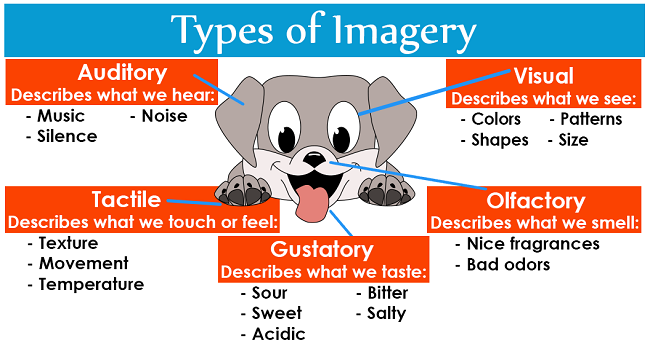
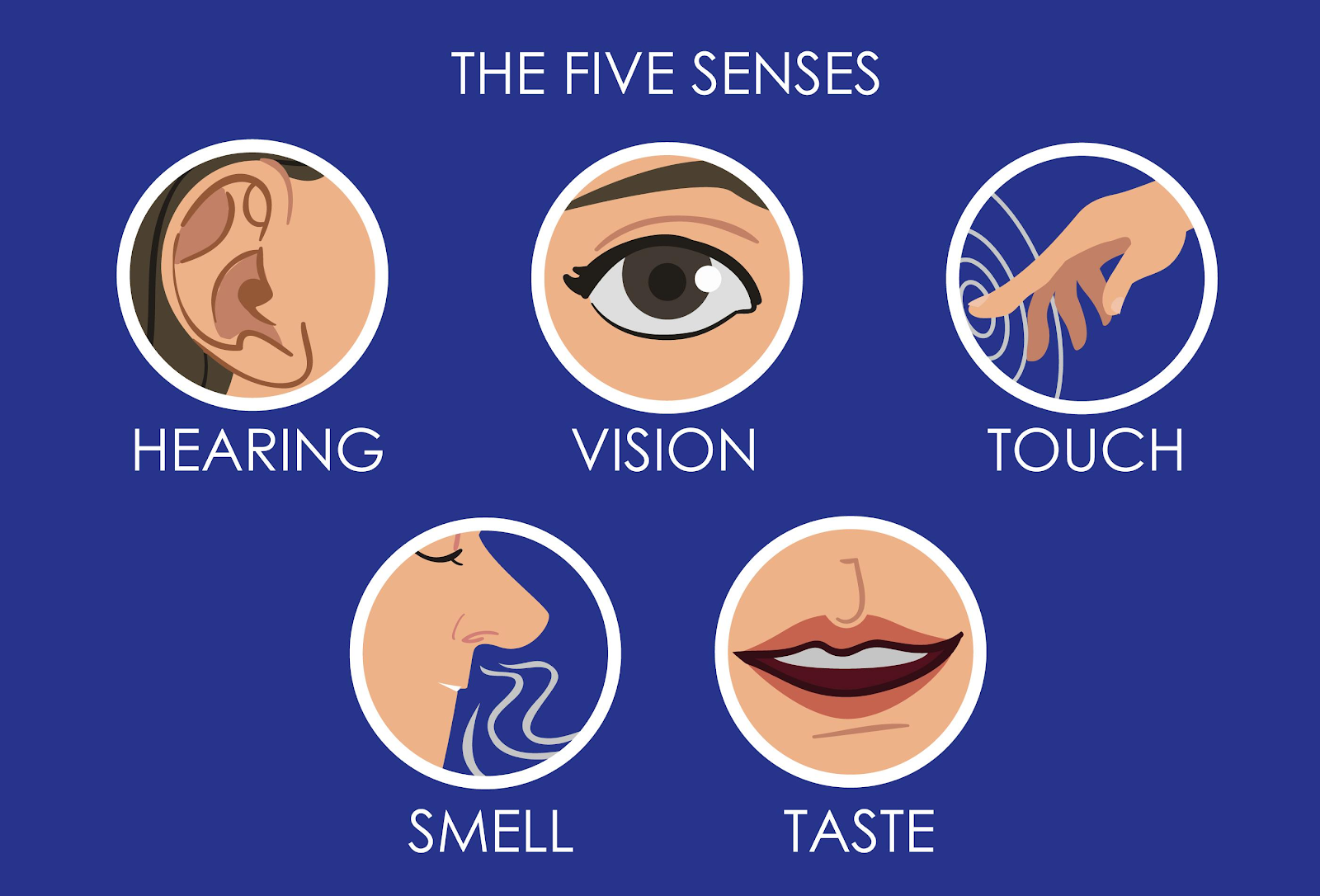
The class later concludes that the key takeaway is that imagery involves all five senses and not just what you see like what a lot of people believe. Most people, when asked for the definition of imagery, describe it as something that helps make a picture in our mind. This definition is limiting because that’s not what imagery actually does. Ultimately, it could be described as the end goal of what happens but it is only because it evoked your five senses that caused the image to surface. For example, one of our first lessons of the school year was based on pizza and imagery related to it. The short texts we read used words such as “aromatic,” “basil,” “ooey-gooey cheese” to create the image of pizza inside of our heads. In the end, this happens because our senses were exposed, in this case to pizza, to the smell and taste before based on our memories. In conclusion, imagery is a lot more than something that makes an image in our head; it is something that awakens our senses if done correctly. 


Following this revelation, the class is provided with some poems that utilize imagery and our five senses to paint a picture in our head. Spirit reading is done. 


Examples of the poems:

“the clouds collapsed,

they’re touching the ground

trying to come alive,

but they can’t.


Images from a landscape are used to indicate hopelessness,

My heart was warm,

Like the swelling waters of the ocean,

Just basking in the first rays of morning sun


Natural images (ocean and sun) are used to express joyfulness 


I felt the end of something great,

Like when you take the last bite of birthday cake,

And all that’s left is a few powdery crumbs on your frosting streaked dish

Images of birthday cake are used to create feelings of melancholy and sadness”


At this point, we as readers can definitely relate to the poems above in some ways. After mentioning this brief connection, the class proceeds to spirit read a poem called “Fast Break” as written by Edward Herschel. 


Link to the poem: “Fast Break” by Edward Herschel

https://www.poetryfoundation.org/poems/49100/fast-break


After spirit reading the poem, the class was asked the following questions.

  • “From a structural standpoint, what do you notice about the structure of the particular poem? What things stand out to you about the way it was structured?” 


The answer is that the poem is a very long run-on because of the lack of punctuation. There is only one period throughout the poem and the structure is just two lines straight through with a few commas here and there. The class is then split up into their groups and put into break out rooms to utilize the TWIST strategy in order to get the gist and them of “Fast Break.” 


For homework, we are assigned to write a poem about a pastime we feel most passionate about. The poem is free versed and should use diction and imagery. The poem should be at least 20 lines long. 


Reflection of the day’s lesson:

Through this lesson, I have learned about free-verse poems and imagery. Free-verse poems are very irregular in terms of structure, rhyme, and length. For example, “This is just to say” written by Edward Herschel is a freestyle poem that has a very different structure as compared to other poems. The poem is written as if in sentence format and there is no punctuation used. Additionally, there is no rhyme nor rhythm throughout the poem. Learning to read free-verse poems can be important because it helps in identifying and understanding the message the author wants to convey. Additionally, it can help students in becoming good readers by classifying different types of poems Other than learning about free-verse poetry, we were also taught about imagery. Although we usually think of imagery as something related to giving the readers a mental image, it is more than that. Imagery is something that involves all five senses being evoked in order to help the reader understand what the author is describing. Although it is in fact related to mental images, in the end, there is a lot more to imagery than what most people think. This is important because knowing the true meaning of imagery is vital to being a good reader because writers use imagery all the time to describe things so that the reader can understand and relate. To conclude, learning the structure of free-verse poems can help students familiarize themselves with its concept while learning the definition of imagery can aid in understanding and relating to the author’s words and descriptions.

Blogger #3, Emily Chen, Period 2, 11/4/2020, Day A

 Aim: How can we use the poem, “This is Just to Say” by William Carlos Williams as inspiration for our own poems?

Do Now: Describe a time when you or someone you know did something that was “technically wrong” and you should have felt sorry for it but you didn’t?

The class was given time to write a response to the question. Many students shared funny stories about shoplifting, messing with siblings, and more. A recurring aspect among the stories is that the person should’ve felt guilty for their poor actions, but didn’t due to various reasons. This activity introduced students to the basic gist of “This is Just to Say” poems.


Notes & Class Discussions:

The class read William Carlos Williams’ “This is Just to Say,” discussed the origin and structure of the poem, and read a few variations of the poem. Williams’ poem is a free verse, because it doesn’t have a regular rhythm, syllabic count, rhyme, nor punctuation. After, students were given 5 minutes to write our own “This is Just to Say” poems. The student who wrote the most was Rory, with a total of 11 poems. The poems discussed dark topics, such as murder and hopelessness. One poem is as follows:

“I lied to you.

I know it was wrong and it

Hurt you more than I wanted.

But the expression on your face,

It’s so exhilarating, that dismay.

I savor every parcel of your despair.”

Next, students learned about the significance of imagery in poetry. Imagery is a literary tool that allows readers to feel the speaker’s emotions and visualize the situation being described. It awakens the reader’s senses.

The class watched a YouTube video from “The Red Room Company” that expands on the concept of imagery and provides a poem that uses an abundance of it. 

(https://www.youtube.com/watch?v=UxASvORGoG4&ab_channel=TheRedRoomCompany) 

In the following verse, the imagery describes the tranquility of the atmosphere and captures the speaker’s positive attitude towards her beloved tree:

“I feel different, one with nature,

Up here in the wind, all wild and free,

As if I am connected to the universe,

Me, a small leaf, hanging from my tree.”

Afterwards, the class had to read and annotate “Fast Break” by Edward Hirsch, a poem about teamwork in basketball. Then, students had to complete a “TWIST” chart that discussed the tone, word choice, imagery, style, and theme of the poem. The author establishes an intense tone through the use of captivating word choices with positive/negative connotations and figurative language, especially similes. The author uses detailed imagery to describe the astounding precision of the players and their ability to confuse the opposing team. The style is evocative and the theme is that teamwork is key to success.


Reflection:

Today, I learned about the origin and structure of William Carlos Williams’ popular “This is Just to Say” poem. It taught me that poetry doesn't always need to have a steady rhythm or a proper rhyme. A poem is a form of expression that allows the reader to feel. Furthermore, I learned about the importance of imagery, how it can completely evolve a poem, and how it can stir up emotions within the reader. The reason I learned about such topics is because to be a good reader and writer, I must educate myself on various types of writing, including poetry. By studying the figurative language in poems, I can uncover hidden meaning(s) and understand the theme(s) that the author is trying to convey. I will use what I have learned about poetry and imagery to analyze books, passages, articles, and poems that I read on my own. Moreover, I can use this newfound knowledge to write my own poems.

Blog #2, Ada Cen, Period 2, 11/4/2020, Day A

 Today’s Aim: How can we use the poem, “This is Just to Say” by William Carlos Williams as inspiration for our own poems?


The do now for the day: THINK/PAIR/SHARE Describe a time when you or someone you know did something that was “technically wrong” and you should have felt sorry for it but you didn’t? 


Before we started getting into today’s lesson, as a class we spent some time on housekeeping, we are starting to do blogs. Ms. Peterson went over the blogging system, who’s the first three students that are doing the blogs and the job of the blog masters. We went over that the students who are doing the blogs are going to send their blog to the blog masters. Additionally, we went over how the blog masters are able to use the blogging sheet to organize the students’ blogs. For instance, if a student is missing a blog, the blog masters are able to highlight the student’s column in red to indicate that they are missing their blog. Moreover, students are also capable of viewing the blogging sheet to know when they are doing their blogs.   


(An example of the blogging sheet, this is for period 2)


Afterwards, we moved on to the actual lesson. As mentioned above the aim for today was, how can we use the poem, “This is Just to Say” by William Carlos Williams as inspiration for our own poems?, and for the do now, it was, describe a time when you or someone you know did something that was “technically wrong” and you should have felt sorry for it but you didn’t? We discussed the do now question together, and some of us shared our own story with the class. Thus, many of the stories shared by the students were regarding their siblings. For instance, one student had said that she shares a room with her younger sister, who apparently is a messy person, and so she made a mess and blamed it on her as revenge. Connecting back to the do now, she didn’t feel sorry for her actions, even though her actions weren’t necessarily right.


Next, we moved on to slide 2. Slide 2 contains a poem, “This Is Just To Say”, by William Carlos Williams, in which we read by spirit reading. To add on, the poem talks about apologizing for eating someone’s plums, which were saved for their breakfast, but also telling them how they couldn’t resist themselves from eating it. Additionally, after reading the poem we talked about what the poem is showing. We discussed that when we apologize for something we have done and then justifying our actions with but, is saying how we aren’t sorry for our actions.   


Afterwards, we moved on to slide 3. Slide 3 contains information about the poem on the previous slide. The poem, “This Is Just To Say”, by William Carlos Williams, is a poem written as a quick note to his wife one morning, and later became one of his most popular creations when he published it in 1934. Furthermore, the poem does not contain any rhythemes, rhyme scheme, and syllabic counts, and has very limited punctuations. Thus, the poem takes up approximately 20 seconds to recite.


On slide 4, students were given examples of variations with the theme of the poem, “This Is Just To Say”, from previous slides. We used spirit reading to read the slide, three students had volunteered to read. Additionally, all three of the poems share a common theme with the poem, “This Is Just To Say”. The common theme is that apologizing for a wrong action but then also justifying your actions isn’t necessarily showing you’re sorry for your actions. 


We then moved on to slide 5, which contains directions for a small activity. Students are asked to create as much variation of the poem, “This Is Just To Say”, as they could under five minutes. Thus, students aren’t required to have poems that match up with the amount of line in the original poem, just the concept of it. Furthermore, the student with the most poems created within the time limit of five minute will be the winner of the game, in which they will also win 30 points for their team. Students were then given five minutes to come up with as many poems as they could on their own. After the five minute was up, the student who believes they have a lot will share their number of poems. Once, no one else has a greater amount of poems, they will share all their poems with the class, to make sure they are acceptable and meet the requirements. To add on, in our class the student with the most poems has 11 and was asked to share all her poems with the class. She was declared the winner of the game and she had earned 30 points for her team, team 6, of period 2, to be exact. 


After we wrapped up our small activity from slide 5, we moved to slide 6. Slide 6 is about imagery in poems. Students were provided with information regarding imagery in poetry. For instance, imagery in poems helps the reader feel what the author feels. Additionally, imagery in poems help stimulate one’s hidden feelings that are often unexpected. Students were provided with a link to a video, which helps the student to have a better understanding of the poetic device, imagery. For instance, the video talks about how languages are used in poems to awaken the five senses of the reader and that imagery stimulates imaginations. Thus, after the class watched the video we had discussions about it. Students were asked what was the key takeaway of imagery? At the end of the discussion, students learned that the key takeaway of imagery was that it provides words that stimulate the five senses, it stimulates past experiences through the five senses.


(The image shows examples of imagery used in poems that help stimulate the reader’s five senses)

The link provided to students on slide 6: Poetry Object Poetic Device #2: Imagery | ClickView [2:31]   


Additional link to help student understand imagery better


Next, we moved on to slide 7, which contains more poems. We read the poems as a class together. Moreover, slide 7 shows examples of poems that have imagery of landscape, natural images, and food. Poems use imagery of landscape to indicate hopelessness, natural images, like the sun and the ocean, for joyfulness, and food, the remainder of the food, to generate melancholy and sadness.


We then worked our way over to slide 8 and 9, which happens to be another poem. The poem was called, “Fast Break”, by Edward Hirsch. We used spirit reading to complete the reading of the poem. Students were also asked to annotate the poem as we read. The poem was about a game of basketball, the poem uses descriptive words to describe the game to the readers. After reading the poem, we had a little class discussion regarding it. As a class we were able to see that the poem, “Fast Break”, had very limited amount of punctuation, except for commas.


After reading and discussing the poem, “Fast Break”, on slide 8 and 9, students were then asked to complete slide 10. Slide 10 consists of a “TWIST” chart, which students were supposed to complete with their teammates. Students were put into breakout rooms with their teammates to complete the chart together, the students were given 8 minutes to complete it. Unfortunately, after the 8 minutes, we didn’t have much time left in class to discuss the chart as a class. 


Finally, after the students were given 8 minutes to complete the chart on slide 10,  

Ms. Peterson went over the homework. Students are expected to finish the lesson, if they haven’t already done so, and turn it in. Additionally, students were also given homework in addition to finishing the classwork. The homework that was assigned today is for the students to create a poem regarding a pastime experience that they feel passionate about. The poem that each student is required to create should be a free verse poem that uses precise word choices and imagery, as well as other poetry devices. Thus, the poem should have at least 20 lines, have a title that fits with the poem’s topic, and the poem should also contain a relative image or artwork.


Self Reflection of today’s lesson:


What did I learn?

I learned what the poetic device, imagery, is. I learned that imagery is more than just creating an image in the reader's head, it uses descriptive words to help provoke and stimulate the reader's five senses. By doing so, the five senses can then help provoke a past experience of the readers to help them get a better understanding of the poem. Thus, since imagery helps stimulate the five senses of a reader, it can help the reader connect better with the author and understand the author’s point of view better. For instance, the author can use imagery to help the reader feel what they’re feeling. 


Why did I learn it?

I learned this so that I can understand what the poetry device of imagery is. Additionally, understanding imagery better can allow me to identify the use of imagery in poems that I read. Being able to identify the use of imagery in a poem can help me understand the poem better. I will be able to understand what the author is trying to provoke in my mind, whether it is a feeling, emotion, or one of my senses. For instance, if an author uses imagery to help me feel what they feel, I will be able to identify that, that way I can feel what the author wants me to feel.


How will I use what I learn?

Like mentioned above I will be able to use my understanding of imagery when reading poems. Thus, I can use my knowledge of imagery when writing my own poems. I can use imagery to help the reader understand and connect better with my poems. For instance, since imagery provokes one’s five senses and past experiences, using imagery in poems will allow them to connect better with my poems. Furthermore, using imagery in poems can help my readers understand my point of view and feelings better. The usage of imagery will allow me to connect with my readers, they will be able to better understand and feel what I think and feel.


Friday, November 6, 2020

Blogger #1 - Jacob Berger - Period 1 - 11/04/2020 - Freshman Lit 2021 Day A


Blog #1 - Jacob Berger - Period 1 - 11/04/2020 - Freshman Lit 2020


Aim: How can we use the poem, “This is Just to Say” by William Carlos Williams as inspiration for our own poems?


The Do Now from today’s lesson was to “Describe a time when you or someone you know did something that was “technically wrong” and you should have felt sorry for it but you didn’t?”


We started by coming up with examples of times when we did something wrong, but did not feel guilty about it later. One time I chose when I did something wrong but did not regret it was when I ate all of the bread in the kitchen because I really liked it even though I knew that others like it, too. I did not feel guilty because I knew that there would always be a chance to buy it again and that I liked it more than anyone else. After talking in a group, we all found out that everyone had a point in their life that they did something wrong but did not feel guilty because they felt that it was not a big deal.


Later, we read a poem called “This is Just to Say” by William Carlos Williams. This poem describes a man leaving a note on his fridge apologizing for eating the plums in the fridge while also saying that they were delicious. This poem was not something one would think important, but it turned out to be one of his most famous poems. This poem's difference from other poems was that it was a free-style poem, meaning that it did not follow the rules or boundaries of standard poems such as rhyming. At the same time, this poem had a very specific meaning to it having to do with apologizing for something that you did wrong, but not actually feeling sorry about that action.


The next thing we did was learn what imagery was and why it was used:

  • … Image is the root word of imagination. It’s from Latin imago, “picture,” how you see things. Images carry feelings. Saying, “I’m angry,” or “I’m sad,” has little impact. Creating images, I can make you feel how I feel.
  • Writing poems using images can create an experience allowing others to feel what we feel.
  • Perhaps more important, poems can put us in touch with our own often buried or unexpected feelings.


We then watched a video about imagery and the poem “My Tree”, by Jack.

https://www.youtube.com/watch?v=UxASvORGoG4&ab_channel=TheRedRoomCompany

After watching this video, I realized that imagery was a device to help the poet paint an image in the reader's head of the thing that they are trying to explain to them. This gives the reader more context and a better understanding of the topic of the poem.


We then read two poems about hopefulness, joyfulness, and sadness, and the feeling of playing a fast-paced game of basketball. The first one showed three pictures along with the poem to help the reader imagine what the poem was trying to say.


the clouds collapsed,

they’re touching the ground

trying to come alive,

but they can’t.


This stanza in the poem along with a picture of a dark red sunset is trying to create a sense of hopelessness.


After talking about the meaning of these two poems, we finished by individually creating a “TWIST” chart for the second poem to show our understanding of the poem. It also helps to understand your own ideas about the poem.


T

Tone

Fast-paced action on the basketball court.


W

Word Choice

The author talks about basketball and the feeling of intensity one would feel while playing.


I

Imagery

The author describes the feeling of playing in a basketball game.


S

Style

(the result of choices in T, W, & I)

(i.e. thought-provoking, contentious, evocative, elegant, etc. )

Thought-provoking because it leads one to think about the feeling of playing the game rather than just the game itself.


T

Theme

How it feels and what experiences people get from playing a fast-paced game of basketball.


Interpretative Statement

This poem talks about the feeling that one experiences when playing basketball with their teammates. It talks about the intensity they feel and it leads the reader to ask themselves how it would feel to play rather than just thinking about the game in itself.

Reflection:
Overall, during the class we learned about what imagery is and how to use it. Imagery is one part of the “TWIST” chart that was learned about and used in the poem. We learned about the poem “Fast Break” By Edward Hirsch. We also learned about how imagery is used together with the rest of the poem, so that the pictures and words that create a picture in the reader's mind make sense according to the rest of the poem.

Blogger #3- Jordan Chen Period 1 - 11/4/2020 Freshman Lit 2021 Day A


Blog #1 - Jordan Chen - Period 1 - 11/04/2020 - Freshman Lit 2021

Aim: How can we use the poem, “This is Just to Say” by William Carlos Williams as inspiration for our own poems?


The Do Now from today’s lesson read as follows:


“Describe a time when you or someone you know did something that was “technically wrong” and you should have felt sorry for it but you didn’t?”


Firstly, One time that I did something that was “technically wrong” that I should have felt sorry for but didn’t, was when I got revenge on my sibling by “tattling” for a incredibly petty reason (I believe that it was because my sister teased me and refused to let me get what I wanted) and although it was wrong, I never regretted my decision because it was that day that I learned that revenge was a dish best served cold. This activity really made me think about all the petty revenge that I took on others for (most commonly) incredibly petty and trifling matters. While speaking together in a group, I realized that others also seemed to have had such experiences in their childhoods as well, Each one of us also expressing a similar experience, showing that we as a whole have made at least a couple poor decisions due to our young age and lack of maturity.


Secondly, we were to read “This is Just to Say” by William Carlos Williams. A poem that describes a man who left a note to his wife to apologize for eating the plums in the fridge. Such a poem is often a trivial matter, although this is not the case for this poem that became very popular when it was published back in 1934. This may in part be due to the unique style of this specific poem. From speculation, this poem differs from others because of its “Free-style” nature while still being a “controlled” poem with a meaning. As such it acts as an apology while also not exhibiting any sense of guilt. While the different variations of said poem also portray such aspects as stated previously.


“I chopped down the house that you had been saving to live in next summer.

I am sorry, but it was morning, and I had nothing to do

and its wooden beams were so inviting.”


“I gave away the money that you had been saving to live on for the

next ten years. The man who asked for it was shabby

and the firm March wind on the porch was so juicy and cold.”


Next, While creating my own “This is just to say” poems I realized just how hard it was to create poems from scratch. Within 5 minutes I was only able to come up with a singular puny poem that was a joke compared to those made by others. My own skills in coming up with creative ideas were mediocre, especially when forced to create poems on the spot that satisfied the guidelines set by normal “This is just to say” poems. A fact all the more obvious when the discussion began and others shared the numerous poems they came up with in the same span of time, and while those that were shared may not have been a polished final product, they were at least presentable with the basic concepts intact. The first of which is The construction of an idea around the base that is an apology without an admission of guilt.


One of these outstanding examples from a classmate being:


“I didn't do my homework

I left it on my desk

I'm sorry but I'm tired

I really need a rest”


Following this we began to learn about imagery:

Following this we began to learn about imagery:


  • … Image is the root word of imagination. It’s from Latin imago, “picture,” how you see things. Images carry feelings.  Saying, “I’m angry,” or “I’m sad,” has little impact.  Creating images, I can make you feel how I feel.


  • Writing poems using images can create an experience allowing others to feel what we feel. 


  • Perhaps more important, poems can put us in touch with our own often buried or unexpected feelings.

Link: https://www.youtube.com/watch?v=UxASvORGoG4&ab_channel=TheRedRoomCompany


After watching a video, I quickly grasp the benefits and reasoning behind such imagery that allows the reader to fully realize that which I am trying to bring to life on a page, and after discussing such benefits provided by imagery, we quickly move on to the examples provided within the following slides. Of which give us a deeper understanding of the material as the images and text provided in the following slide give us the basic idea of how such ideas can be put into use in every poem and understood even subconsciously. Such as:


“the clouds collapsed,

they’re touching the ground

trying to come alive,

but they can’t.”


Such information that is provided flows into the material provided in the following slide which contains a poem with large quantities of vivid imagery, of which the class begins to annotate, such as:


“and for once our gangly starting center
boxes out his man and times his jump

perfectly, gathering the orange leather
from the air like a cherished possession”


These two stanzas provide a clear image in my head about the topic in this poem.

An important aspect to understand is the impact that good imagery has on a poem, as while on one hand, good imagery can help the reader understand more about the poem in its entirety, it also keeps it entertaining.


After finishing the annotation in the previous slide, we end off on the last slide of the class activity. The “TWIST” chart that we are to use on the poem stated in the previous slide helps to determine the theme and statement of the poem.


T

The tone exhibited by the poem portrays a triumphant end to a hard fought match.


W

With such word choices as “Helplessly, swivel, perfectly, falling” the poem perfectly portrays the movement of the ball in the heat of the match.


I

The imagery provided connects the players point of view with that of the readers, using vivid imagery to painstakingly describe every movement of the ball from the perspective of the players.


S

(i.e. thought-provoking, contentious, evocative, elegant, etc. )

The result of the choices made for “T,W,I” leaves the reader with a lot of tension between the ball and players and eventually relieving this stress when the ball eventually goes into the hoop.


T

Through teamwork you can support each other through defeat and share victories.


The author uses tension between both the teams and the ball to create a vivid image of teamwork and stress in the heat of the moment and through perfect teamwork, the tension is erased one the ball goes into the hoop and the team is victorious. 

Reflection:
Today's lesson, overall taught me the basics of imagery, how to integrate imagery into my own poems, and the slight difficulties that come with creating or parodying a poem. The multiple examples provided by the slides allowed for me to have first hand accounts on how to create such poems and the boundless benefits of having vivid imagery. Such examples set up the following slides that push us to use the information that we learned in class in order to create parodies of “This is just to say” and the use of imagery in such a poem. To recap, this lesson taught me the basics of poetry, the use of imagery in poems, and the thought provoking nature of the correct use of imagery within a poem.

Monday, September 14, 2020

Welcome to Ms. J. Peterson's Class Blogging 2021!

Dear Students and Families,

I am so excited to welcome you to my 2021 classroom blogging initiative! Student blogging has an important role in our classroom because each student will function as a "scribe" and be responsible for group learning.


We had a great deal of success with posting blogs in 2019 and 2020.  


GOALS:
  • To become effective global communicators.
  • To have every voice speak with the same volume.
  • To summarize and reflect upon each day's lesson.
  • To become responsible digital citizens.
  • To become creators of information.

Technical Requirements of the Blog
  • THREE students per class, per cycle will be responsible for blogging. Blogs will be checked on the next cycle. (For example: Blogger #2, John Doe is in Period 5, Day B. If Day B is September 17th and that is his turn to blog, his blog is due by September 21st - the night before  the NEXT Day B.]  
  • Additionally, All blogs MUST be submitted to the assigned Blog Master no later than 9 pm of your due date; to ensure they have proper time for posting.
  • Title of the blog should include:
    • Student's Assigned Blogger #, Student's full name, class period, date, and cycle letter. 
      • (For example: Blogger #2, John Doe, Period 5, 9/17/20, Day B).
    • Please use the date assigned, NOT date due.
  • Blog Masters MUST LABEL their blog with “Freshman Lit 2021.”
  • Students are responsible for keeping track of when it is their time to blog by keeping track on the Blogger Sheet, which can be found via the Peterson Fresh Syllabus.
  • Students are to comment and respond to one another, including asking questions or asking for clarification.
  • Blogs will be published on the world wide web, so we must practice digital citizenship and remember that our audience is GLOBAL, so our tone is FORMAL.

How to make sure your blog is formatted correctly?

  • Create your blog using Google Docs and use the Share Feature to provide your document to the blog master. This usually creates the easiest method for posting a blog that is formatted the way you wanted it. 
  • If you're experiencing formatting issues, which can occur when capturing pictures and such from the internet, the best way to correct the formatting issues is to avoid copying and pasting the information from the document, until you have used the Clear Formatting button on the task blogger bar (it's the last icon on the right).
When Do I Blog?

Please refer to the Google Sheets Blog Date List.

Sample of Excellent Blogs
Sample of Excellent Blogs (They had different requirements)

What does your blog grade mean?
  • A+: Great work, you nailed it! You covered an amazing multi-media summary of what happened in class using a clear, easy-to-read format. Most importantly, you absolutely included fantastic reflection which addresses all three main questions.
  • A/A-: You covered a multi-media summary of what happened in class using a clear, easy-to-read format. You may need to elaborate slightly or you may need some tweaking in your area of reflection.
  • B: Your summary got the general gist of what happened in class, but could definitely use some elaboration. Your reflection may be very basic.
  • C: You probably didn’t include a reflective aspect at all or your summary was so minimal it was hard to have any idea what happened in class.
  • >C-: Incredibly basic and/or the tone was rude, offensive, or inappropriate for a school, public blog.
  • M: No blog written on your assignment day.

Blog Revisions and Reflections
  • Blogs will receive a grade within approximately 7 days of publication based on the rubric above.
  • Blogs may be revised, edited, and updated if the student would like an opportunity to improve his/her grade, however, they MUST do so within 7 days of receiving their blog grade. 
  • IF the student does opt for a revision, he/she MUST EMAIL ME, via by responding to the original PupilPath message that was sent, coupled with a direct link to the NEWLY UPDATED ORIGINAL published blog to inform and notify me to check the blog again.